

Chef's Knives
Damascus Cladding vs. San-Mai: What Should You Actually Stock?
Jul
Your customers don’t ask for “clad construction.” They ask for knives that sell. So the real question isn’t which one is better — it’s which one moves off your buyers’ shelves and into working kitchens.
Both Damascus cladding and San-Mai wrap a hard cutting core in a softer, tougher jacket. Same core idea. But they sell to different customers, at different price points, for different reasons. Get the match right and your catalog does the work for you.
Here’s how to think about it.
First, the part most buyers get wrong
The pattern doesn’t cut. The core does.
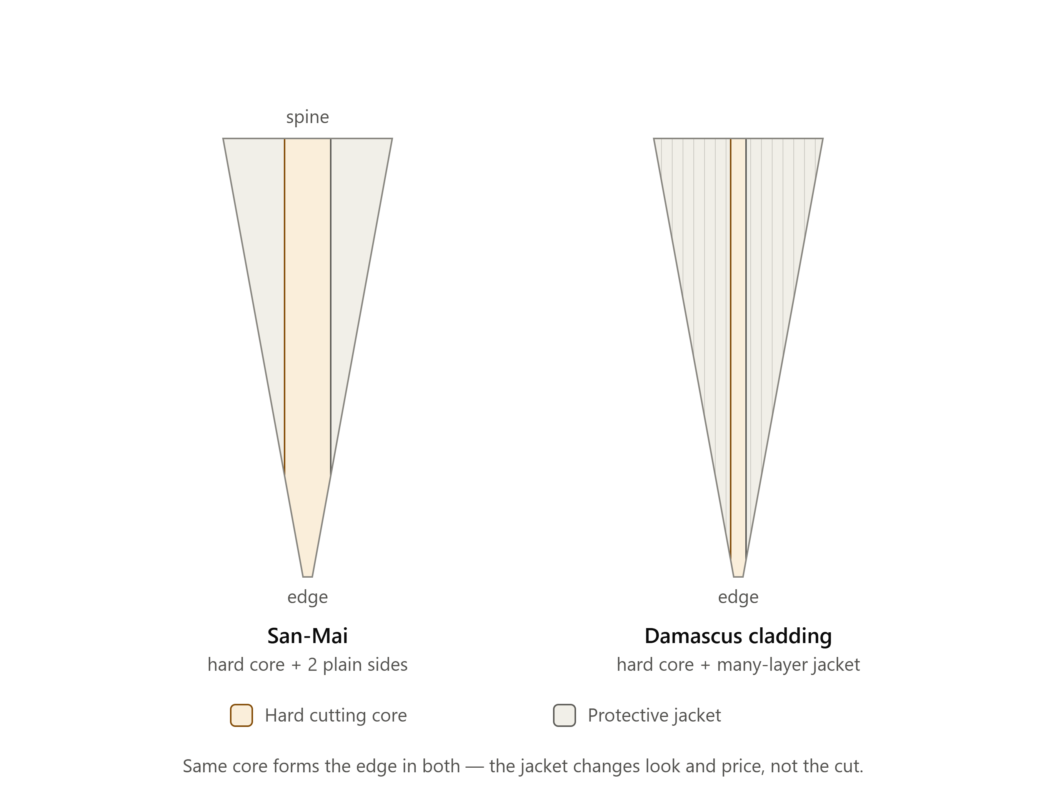
On both a Damascus-clad and a San-Mai blade, the edge is a single hard steel — VG-10, AUS-10, or a high-carbon core — running down the center. The outer layers protect it, add toughness, and (in the case of Damascus) make it beautiful. But edge retention, sharpness, and how the knife performs on a cutting board? That’s the core steel, and nothing else.
Translation for your catalog: if two knives share the same core, they cut the same. A Damascus AUS-10 and a San-Mai AUS-10 are performance twins. What you’re really choosing between is look, price, and story.
That’s not a downgrade. That’s leverage. It means you can sell the same cutting performance at two very different price points.
What each construction actually is
San-Mai is a three-layer build: a hard core sandwiched between two softer jacket sides. The result is a clean blade with a crisp core line running along the edge — understated, precise, and unmistakably a serious tool. Fewer layers means more consistent production and a friendlier cost.
Damascus cladding wraps that same hard core in a multi-layer, pattern-welded jacket. Dozens — sometimes hundreds — of layers are forge-welded, worked, and etched to reveal flowing patterns. No two blades come out identical. More labor, more steps, more wow.
One nuance worth knowing (and worth mentioning to sharper customers): these aren’t strictly opposites. San-Mai describes the architecture — core plus two sides. Damascus describes the jacket — patterned and layered. You can even clad a San-Mai core in a Damascus jacket. But in a catalog, buyers read them as two distinct looks: the clean core line, or the patterned blade. That’s how you should merchandise them.
Where they split — and where it matters to your margin
Shelf appeal. Damascus wins on looks, full stop. It photographs beautifully, it stops a customer mid-scroll, and it practically sells itself in a display case. San-Mai is quieter — a refined, professional look that appeals to buyers who think a flashy blade looks like a gimmick.
Price and margin. Damascus carries more labor, so it carries a higher price — and a higher perceived value. It’s your premium and gift-tier product. San-Mai gives you a stronger value-to-price ratio: mid-premium quality that lands at an approachable number, which matters when your customer is buying by the dozen.
Consistency. Every Damascus blade is unique, which is part of the charm — but it also means more variation to manage. San-Mai is more repeatable, easier to QC, and easier to reorder to spec. If your customer needs 200 identical knives, San-Mai is the cleaner promise.
Care story. Both need the same edge maintenance. Where a jacket or etch is more reactive, patina and upkeep become part of the pitch — a plus for enthusiast buyers, a friction point for volume retail. Match the story to the shelf.
So which do you stock?
Don’t think steel. Think who’s buying it.
Stock Damascus when your customer sells to:
1. Gift and premium retail, where the blade is the reason someone buys
2. Collectors and enthusiasts who want a statement piece
3. Chefs who want a knife that looks as serious as their kitchen
Stock San-Mai when your customer sells to:
1. Working professionals who want a clean tool, not a showpiece
2. Value-driven home cooks trading up to real quality
3. Any buyer ordering in volume who needs consistency and a sharp price
The smart play: stock both, positioned differently
You don’t have to pick. The strongest wholesale catalogs carry the same core steel in both constructions — and let the buyer choose the story.
Same cutting performance. Two price tiers. One inventory strategy that covers the flashy end and the workhorse end of your customer’s market. That’s not indecision. That’s range.
Lead with core steel and hardness on every listing. Let Damascus sell on beauty and San-Mai sell on precision. Give your buyers a reason to reach for both — and a reason to come back to you for the next order.
