

Chef's Knives
Branded Knives for BBQ Brands
Aug
We make branded knives for BBQ brands — pitmasters, restaurants, competition teams, sauce and rub labels. There is no minimum on our stock models, so you can order ten or ten thousand. You choose the blade, steel, handle and finish, and we engrave your logo. Most brands start with a chef knife because it sells to their whole audience, then add a 12-inch brisket slicer as their signature piece.
You already sell merch. Rub, sauce, shirts, hats.
All of it has the same problem. The margin is thin and the brand impression is short. A shirt fades. A bottle of sauce is gone in three cookouts.
A knife stays on the counter for fifteen years with your name on the blade. Your customer uses it every time they cook, and every guest who sees it asks where it came from.
Here is what we can make for you.
Most brands start with a chef knife
This surprises people, but it is what we see most often, and it is a sound choice.
A chef knife sells to your whole audience. Not everyone who follows you is smoking a packer brisket every weekend, but all of them cook. A chef knife is the knife they reach for every day, so it is the easiest one for them to say yes to.
It is also the safest first order. You are not asking your customer to own a specialist tool. You are giving them a better version of something they already use.
The brisket slicer is your signature piece
A 12-inch slicer with a granton edge is the knife that says BBQ.
A brisket flat is wide. Slicing it cleanly in one pass needs a blade longer than the cut, so anything under 10 inches drags and tears. The granton hollows break the suction, so hot wet meat releases instead of sticking.
It is also the best looking knife in BBQ. Every slicing photo on your feed is that blade going through a bark-crusted flat. With your logo on it, your brand is in every one of those shots.
Many brands add it as their second product, or launch it alongside the chef knife as the premium option. If your audience is competition teams or working pits rather than backyard cooks, start here instead.
What you choose
Steel. Single-layer stainless, forged, Damascus-clad, or San-Mai with a carbon core.
Handle. G10, ebony, rosewood, ironwood, olive wood, acrylic and other composites. This decides how your knife looks more than anything else, so it should match your brand and not our catalogue. Send us your colours and we will send options.
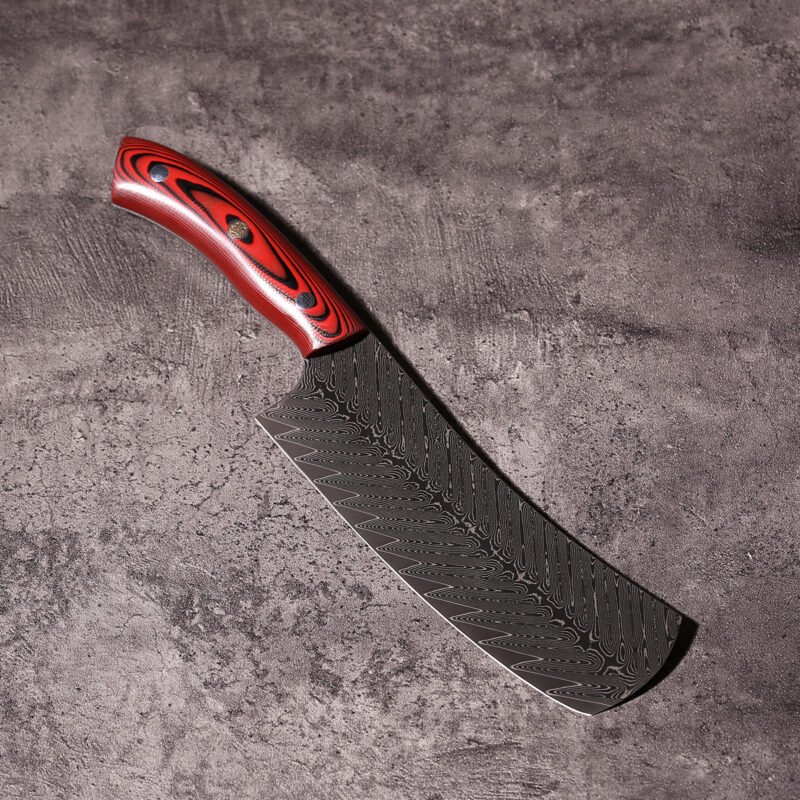
Finish. Kurouchi black textured, satin, or mirror. Kurouchi photographs well against smoke and hides working marks.
Logo. Laser engraved on the blade. It marks the surface without cutting into it, so it does not weaken the blade and does not wash off.
One note on logos. Most BBQ marks are too detailed for a blade. Crests, banners, script and rope borders look great on a bottle and turn into a smudge at 15mm. Send your artwork as a vector file and we will tell you honestly what will read. Usually one strong element works best — the pig, the flame, the wordmark — and the full logo goes on the box.
Packaging. Single-knife boxes or gift set boxes, printed with your branding. We can build for retail shelves or for shipping direct to customers.
What we recommend for BBQ
BBQ is harder on knives than a normal kitchen, so a few things are worth getting right.
Choose stainless, not carbon. Your customers work with brine, vinegar, mustard and wet smoke, and knives often sit dirty during a long cook. Carbon steel will stain and spot in that environment, and the customer will read it as a fault and blame your brand. Carbon sells for more, and we would still rather not sell it for this use.
Think about grip. Hands covered in fat do not hold polished wood the way they hold textured composite. Wood sells better as merch, composite works better in a busy pit. Choose based on who buys from you.
Keep a slicer semi-stiff. A stiff blade fights the shape of a brisket and a very flexible one wanders. A chef knife should be stiff.
Keep hardness sensible. Very hard steel holds an edge longer but chips more easily, and BBQ knives meet bone and board.
Damascus or plain stainless
Both work, for different buyers.
Damascus is your premium version. The pattern looks striking against dark bark, and BBQ is a visual market. It sells at a higher price and it is what people buy as gifts.
Plain stainless is your volume version. Lower price, easier to reorder.
A common approach is to launch stainless first to prove the demand, then add Damascus later as a limited run. Limited runs work well here because your audience already knows them from rub and sauce releases.
Three ways to order
1. White label from stock, no minimum. Our store has finished knives in stock, ready to brand. Order ten, order fifty, order any quantity. No tooling, no development, no waiting for production. This is the easiest way to start, and it is what we would suggest for a first order.
2. Private label, from 100 pieces. Your branding with your own packaging, made as a run. This is the next step once you know the knife sells.
3. OEM, from 300 pieces. Your own blade design, made only for you. This needs tooling, so the minimum is higher.
Most brands move through these in order. There is no benefit in jumping to the end.
Because you have an audience, you can also presell. Announce the knife, run a waitlist or take preorders, and you will know how many to order before you spend anything.
How it works
Tell us your idea. The knife you want, your target retail price and your brand look. We send back a spec and a quote with unit price, engraving, packaging, freight and lead time listed separately.
We sample. You hold the knife before you commit. Slice with it, wash it, use it with greasy hands. Two rounds is normal.
You approve and we produce. Terms are 30% deposit and the balance before shipping.
We ship. Air or sea, quoted at the rate that week. For small orders air is often cheaper overall, so ask for both.
Stock knives are already made, so branding them is quick. A full production run takes around three months on a first order and about six weeks on a repeat.
Tell us what you want to build. Send the knife you have in mind, your target retail price and your logo file, and we will come back with a spec, a quote and a timeline. We are the factory, so the price you get is the price.
