

Chef's Knives
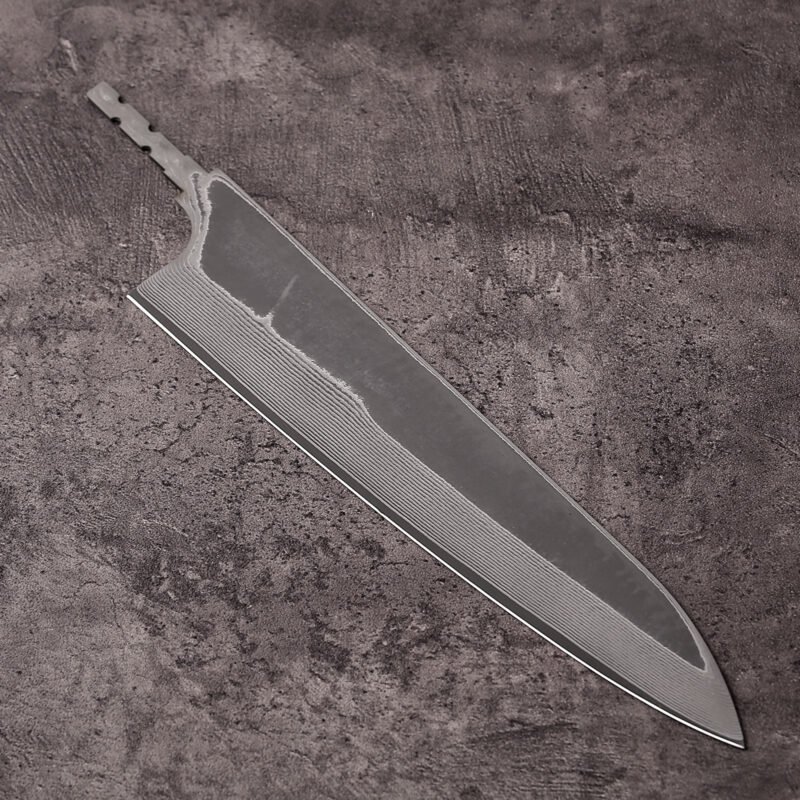
Chef Knife Blanks — Sharpened, Heat Treated, Ready for Your Handle
Aug
Most knife blanks on the market are unfinished stock. Laser-cut outlines, rough forgings, blades that still need profiling, thinning, finishing and an edge before anyone would pay for them.
Ours are not that.
A blank from us is a completed blade. Everything that requires a factory has already happened. The only step left is the one you actually want to do — putting a handle on it.
What is already done before it ships
Profile finished. The outline, the spine curve, the tip geometry — final. Nothing to grind back.
Grind complete. Bevels set, and the blade is at its finished thickness behind the edge.
Heat treated and tempered. Hardness locked in. This is the one step that can never be corrected afterwards, and it is already behind you.
Sharpened. A full double bevel at 15° per side. The blade cuts the day it lands.
Surface finished. Damascus pattern or kurouchi texture, already on the steel.
Tang machined to final dimensions, with cut locking notches where the construction calls for them.
What is left for you
Fit a handle. That is the entire job.
No belt grinder. No profiling. No thinning. No stone progression. No sending blades out for heat treatment and waiting three weeks to learn whether they warped.
This is why blanks work at completely different scales. A woodworker building twenty knives a year and a brand shipping four hundred are performing the same single operation. Between what the blade costs and what the finished knife sells for sits handle stock, epoxy and a few hours — and the hours are yours. If you are weighing this against a full production run instead, we broke those numbers down in what it actually costs to launch a private-label knife line.
Two tang structures, two shopping lists
This choice does not change the blade. It changes what handle material you need to buy.
Full tang takes a matched pair of scales and pins. The 9″ chef knife blank is built this way — full tang, stainless bolster, Western profile. Pick it if your buyers expect a familiar Western knife with visible pins.
Stick tang takes a drilled block and a ferrule. The 240mm chef blank and 240mm kiritsuke blank use a 45mm wa-style tang with cut locking notches, so the epoxy has something to bite and the handle cannot rotate under load. It also opens up materials that would be wasteful cut as scales — ebony, ironwood, stabilised burl.
Settle this before you order handle stock. The two are not interchangeable.
Picking a profile
Paring and utility blanks are the cheapest way to test a handle design, and buyers treat them as an easy add-on purchase.
Santoku is the safest single bet for a general audience. The 190mm with a 440C core and kurouchi hammered finish keeps material cost down while still reading as a serious knife.
Chef and kiritsuke at 240mm are flagship pieces. These are the ones customers photograph, and the ones that justify a premium handle.
Bread blanks are the quiet opportunity. Serrated san-mai is difficult to make well and almost nobody in the custom space offers one.
If you already know your handle design works, a matched set turns it into a product line — a coordinated lineup in one handle material sells for considerably more than the same knives sold loose.
One piece or one hundred
Stock profiles carry no minimum. Buy one to prototype, buy forty when a wholesale account lands. Nothing forces you to commit before you have tested the market.
A custom blade profile — your geometry, your dimensions — starts at 100 pieces. That is the point where cutting new tooling makes sense rather than being buried in a single small order.
Prove your handle on a stock profile first. Very few people get a blade profile right on the first attempt, and a custom run is an expensive place to find out.
Need handle material and pins?
We supply those too, but not off a shelf — handle stock gets cut to what you are actually building.
Send us three things:
Which blank you bought. Stick tang needs a block and a ferrule. Full tang needs a matched pair of scales plus pins. Different parts, so tell us which.
The material. G10, rosewood, ironwood, olive wood, acrylic and similar. Describe the look you want if you are undecided and we will suggest what suits the blade.
Size and quantity. Rough dimensions are fine. We cut to size, so you are not paying for stock you will grind away.
Common questions
What is a chef knife blank?
A completed blade without a handle. Profile, grind, heat treatment, edge and surface finish are all done at the factory. Handle fitting is the only remaining step.
Do I need to profile or sharpen the blank myself?
No. The outline and bevels are finished and the blade arrives with a full double bevel at 15° per side. You need no grinder and no sharpening stones.
What is the difference between stick tang and full tang?
Stick tang slides into a drilled handle block and is finished with a ferrule. Full tang runs the full width of the handle and takes two scales secured with pins. The blade is finished either way; only the handle parts differ.
Is there a minimum order?
No minimum on stock profiles — a single piece is fine. Custom blade profiles start at 100 pieces.
Do you supply handle material?
Yes, cut to size. Tell us the blank, the material and the dimensions.
Start here
Every blade profiled, hardened, ground and sharpened before it ships. Pick a profile, fit a handle, put your name on it.
