

Chef's Knives
6 Knife Problems a 165mm Santoku Actually Fixes
Aug
Nobody replaces a knife because they want a new knife.
They replace it because something about the old one annoyed them one time too many. The potato that stuck. The knuckle that got rapped. The edge that quit by lunchtime.
Here are the six complaints that come up most, what actually causes each one, and what in a santoku’s build fixes it.
Why does food stick to my knife?
Food sticks because a thin film of water between the blade face and the slice creates suction. The larger the flat contact area, the stronger it holds.
This is why potato, cucumber, beet and apple cling while onion and celery do not. It is a moisture problem, not a sharpness problem — and sharpening will not touch it.
Granton dimples are the usual answer. They trap pockets of air along the bevel to interrupt the seal, and they work, partially. The dimples sit in a single row, so the flat above them still makes full contact.
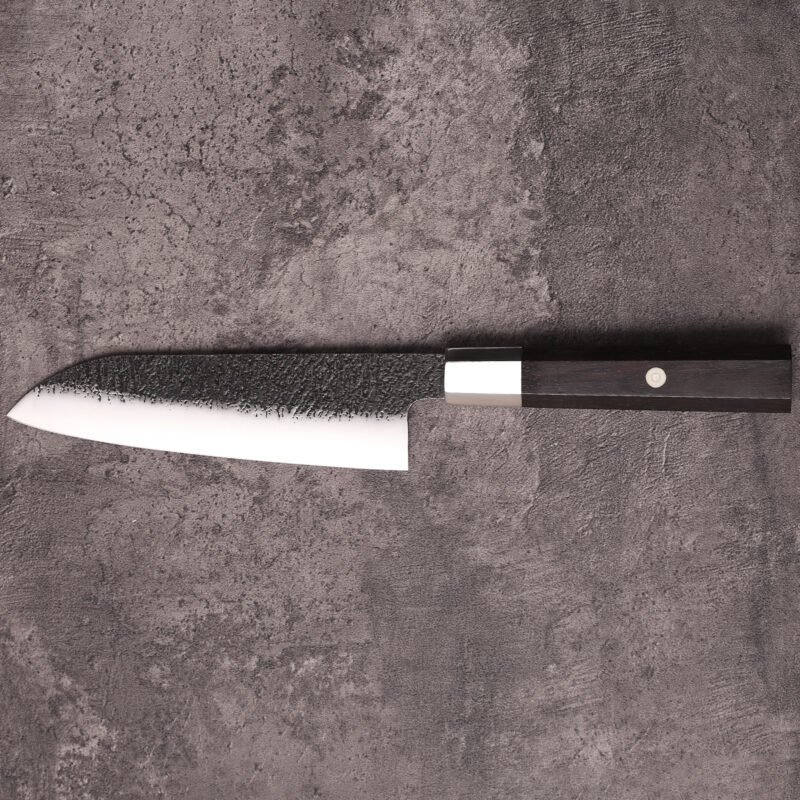
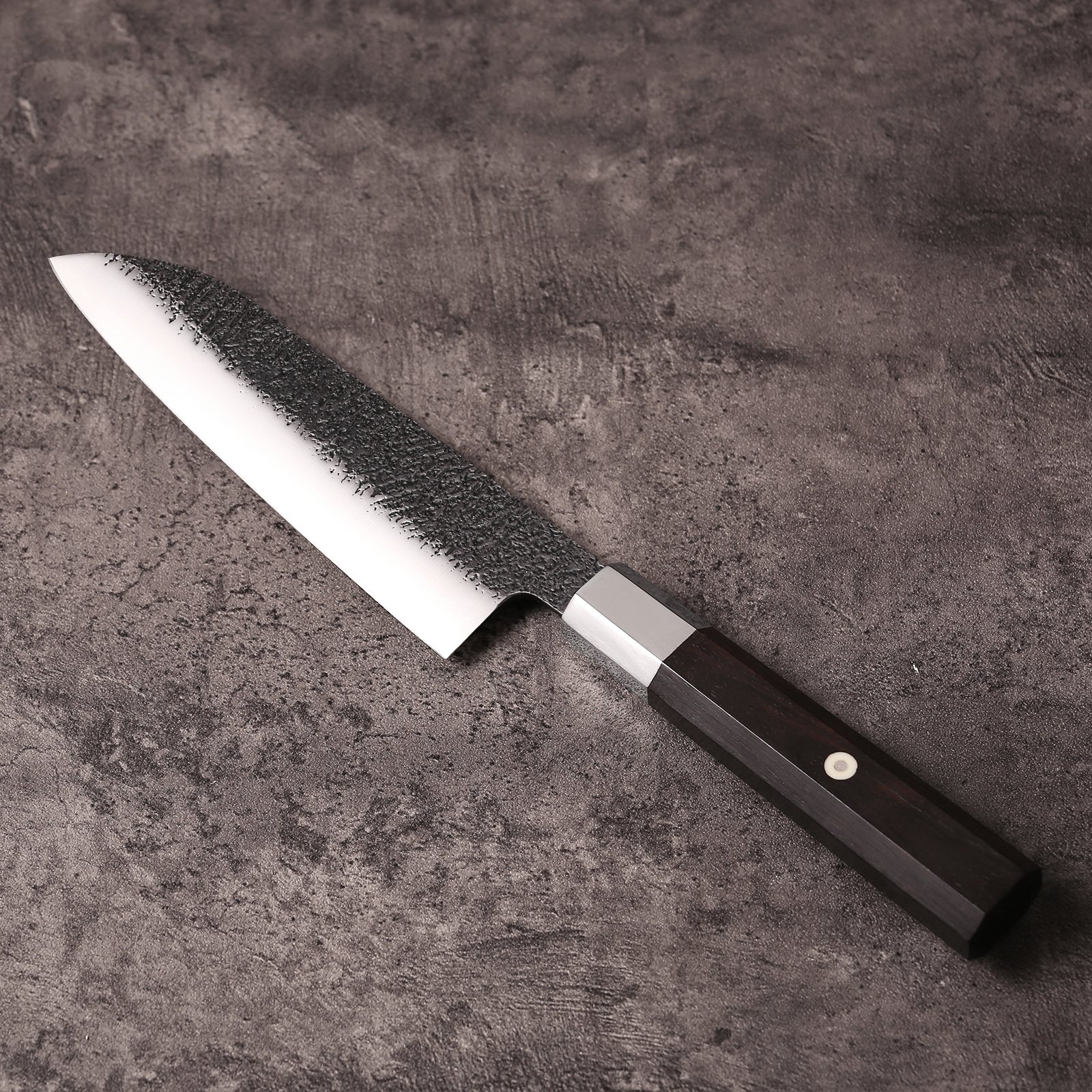
A textured kurouchi-style finish attacks it differently. The whole upper blade is irregular, so there is no continuous flat for water to bridge. Slices break away instead of stacking up behind the edge.
One honest limit: this helps with wet, dense produce. Sticky dry ingredients like dates or soft cheese still need a wipe.
The fix: an irregular blade surface rather than a polished flat.
Why do my knuckles hit the cutting board?
Because the blade is not tall enough at the heel. No grip technique fixes a dimensional problem.
You need enough vertical distance between edge and spine that your curled fingers clear the board on a full downstroke. Under about 42mm at the heel, they will not.
A santoku at 47mm gives you clearance to chop a full board of onions without thinking about hand position once.
That height pays off a second time. A tall blade face doubles as a scoop — cut, lift, transfer, no bench scraper required.
If you have ever finished prep with a red mark across your middle knuckle, this is the spec that was missing.
The fix: 47mm of blade height at the heel.
Why does my knife go dull halfway through prep?
Usually the steel is too soft. But check your cutting board first.
Glass, marble, granite and steel boards destroy an edge in minutes. No knife survives them at any price. Move to end-grain wood or a quality composite and half of all “this knife won’t hold an edge” complaints solve themselves.
If the board is already fine, look at hardness. Below roughly 57 HRC a stainless edge rolls under normal load and needs constant honing just to stay usable.
Around 60 HRC is the sweet spot for a working stainless. Hard enough to hold through a long prep session, soft enough that it comes back on an ordinary 1000-grit stone in a few minutes.
Maintenance should be a habit, not a project.
The fix: 60 HRC, and a wooden board.
Why did my knife chip?
Three causes, in order of how often they actually happen: twisting the blade sideways mid-cut, hitting bone or frozen food, and steel run too hard for the job.
The first two are technique. The third was decided before you ever picked the knife up.
Steel above roughly 62 HRC buys edge retention and pays for it in brittleness. That trade makes sense on a slicer that only ever meets fish. It makes no sense on a knife that lands on a cutting board a thousand times a day.
Blade shape matters here too, and it is the part most people miss. A santoku’s sheepsfoot tip carries far more steel behind it than the fine point of a gyuto or a petty.
On most knives, the tip is the first thing to break. On a santoku, it barely qualifies as a weak point.
The fix: hardness kept at 60 rather than pushed past 62, and a tip with steel behind it.
Do I have to worry about rust?
Not with a stainless blade — and this is where a lot of people get scared away from Japanese-style knives for no reason.
The reputation comes from carbon steel. Traditional carbon blades are superb cutters that will show surface rust if you leave them wet for an hour. They want oiling, immediate drying, and attention that most kitchens will never give them.
A stainless blade with 13–14.5% chromium asks for none of that. The chromium forms a passive oxide layer that repairs itself after every wash.
Two things still apply. Salt, citrus and tomato left sitting on steel can pit even stainless, so rinse after acidic work.
And dry the handle. Ebony is dense and holds up well, but no wood enjoys sitting in a wet sink. The wood is the part that cares here, not the blade.
The fix: stainless steel, a rinse after acidic prep, and a dry handle.
Are santoku knives bad for left-handed cooks?
No. And the worry comes from a real problem with a completely different category of knife.
Single-bevel Japanese knives — usuba, yanagiba, deba — are ground on one side only, and they genuinely are handed. Buy a right-handed one as a lefty and it will steer sideways out of the cut. Left-handed versions get made to order and cost more.
A santoku is double bevel, ground symmetrically on both sides. It cuts identically in either hand. Nothing to specify, nothing extra to pay.
The handle is the other half of the answer, and almost nobody mentions it. D-shaped wa handles are also handed — the flat face is built to sit against one particular palm.
An octagonal handle has no orientation at all. Eight even facets, fully symmetric, identical for everyone.
Those facets earn their keep twice more. They tell your hand which way the edge is pointing without you looking down, and they stop the knife rolling off the board when you set it down mid-prep.
The fix: a double-bevel grind and an octagonal handle, both symmetric by design.
Look back at that list and something becomes obvious.
Sticking is contact area. Knuckle strikes are blade height. Chipping is hardness or a twist. Rust is a carbon steel problem being blamed on stainless. Handedness is a grind, not a curse.
None of it is mysterious, and none of it is about paying more. Every one of these complaints traces back to a number somebody chose — or failed to choose — before the knife was ever built.
That is the whole argument for specifying a knife properly rather than shopping by photograph. Get the height right and the knuckles stop. Get the hardness right and the edge lasts without becoming fragile. Get the surface right and the potato falls off the blade on its own.
A knife that has been thought through does not need technique to compensate for it. It just stops generating complaints — which is the only real measure of a good one.
