

Chef's Knives
The Truth About Damascus Knives: Fake, Cladding, and Hand-Folded — What Every Buyer Should Know
Jun
Damascus knives are everywhere. Browse any knife retailer — online or in a physical store — and you’ll find hundreds of blades bearing that hypnotic, flowing wave pattern. They look beautiful, they photograph well, and they carry a sense of history and craftsmanship that plain stainless steel simply can’t match.
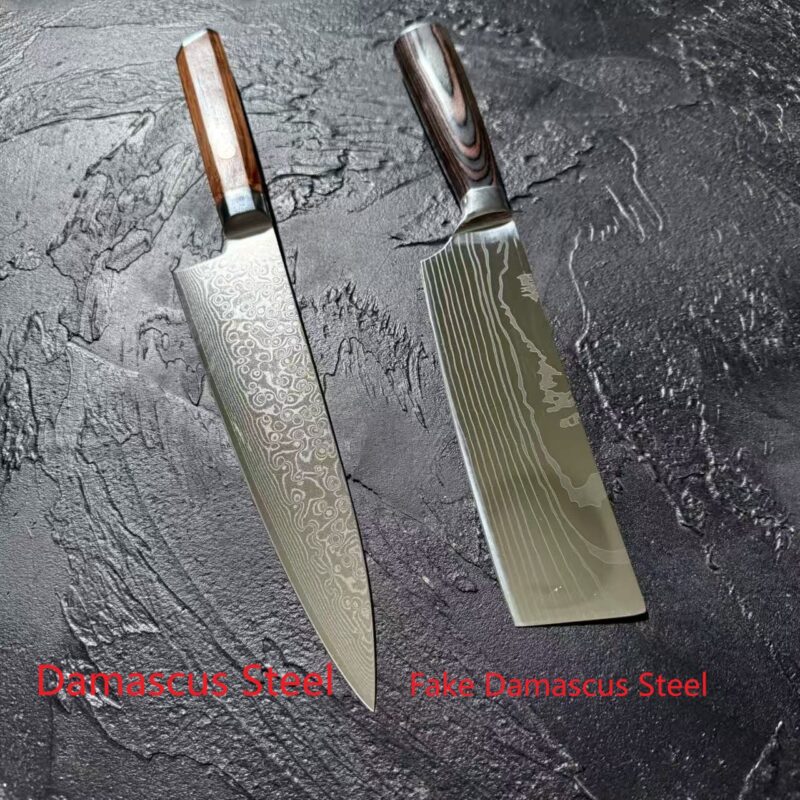
But here’s the uncomfortable truth: not all “Damascus” knives are created equal. In fact, the word “Damascus” is used so loosely in today’s knife market that it now covers three fundamentally different things — a printed surface decoration, a high-performance laminated steel construction, and a centuries-old forging tradition. The differences between them aren’t just technical. They affect how the knife performs, how it ages, and whether it’s worth your money.
Let’s break them down honestly.
Type 1: Fake Damascus — Laser-Engraved Pattern on Stainless Steel
This is the one nobody wants to talk about, but it’s far more common than the industry admits.
Fake Damascus knives are simply stainless steel blades — often a single layer of 3Cr13, 4Cr13, or similar low-carbon stainless — that have had a wave or flowing pattern chemically etched or laser-engraved onto the surface after production. The blade itself is entirely uniform steel, with no lamination, no forge-welding, and no structural patterning whatsoever. The “Damascus” exists only as a visual effect on the surface.
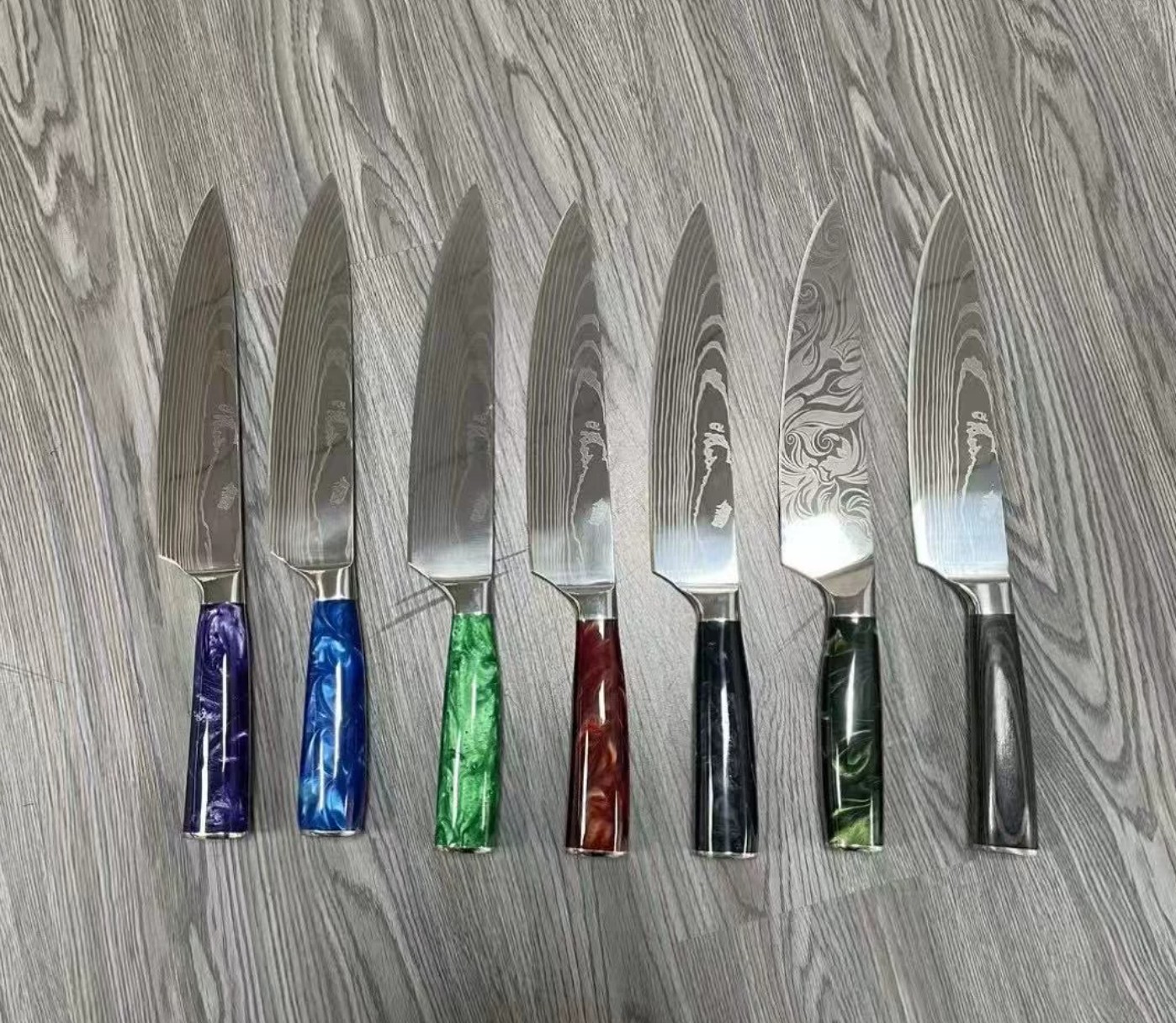
Most people buying a fake Damascus knife never get close enough to see the truth. The product photo, taken from a distance under studio lighting, looks convincing. But bring a phone camera up close and hold it under direct light, and the deception becomes obvious immediately.
The lines are not continuous. In a real Damascus blade — whether cladding or hand-folded — the pattern is formed by the actual boundary between two different steels. Those boundaries are solid, unbroken lines that run the full length of the blade. Under a laser engraver, the machine creates the pattern by firing rapid pulses along a programmed path. Look closely and you’ll see the “lines” are actually a series of tiny dots or dashes — a dotted texture, not a solid boundary. The laser hasn’t created a layer; it’s created an illusion of one by scoring the surface in a repeating sequence of micro-burns.
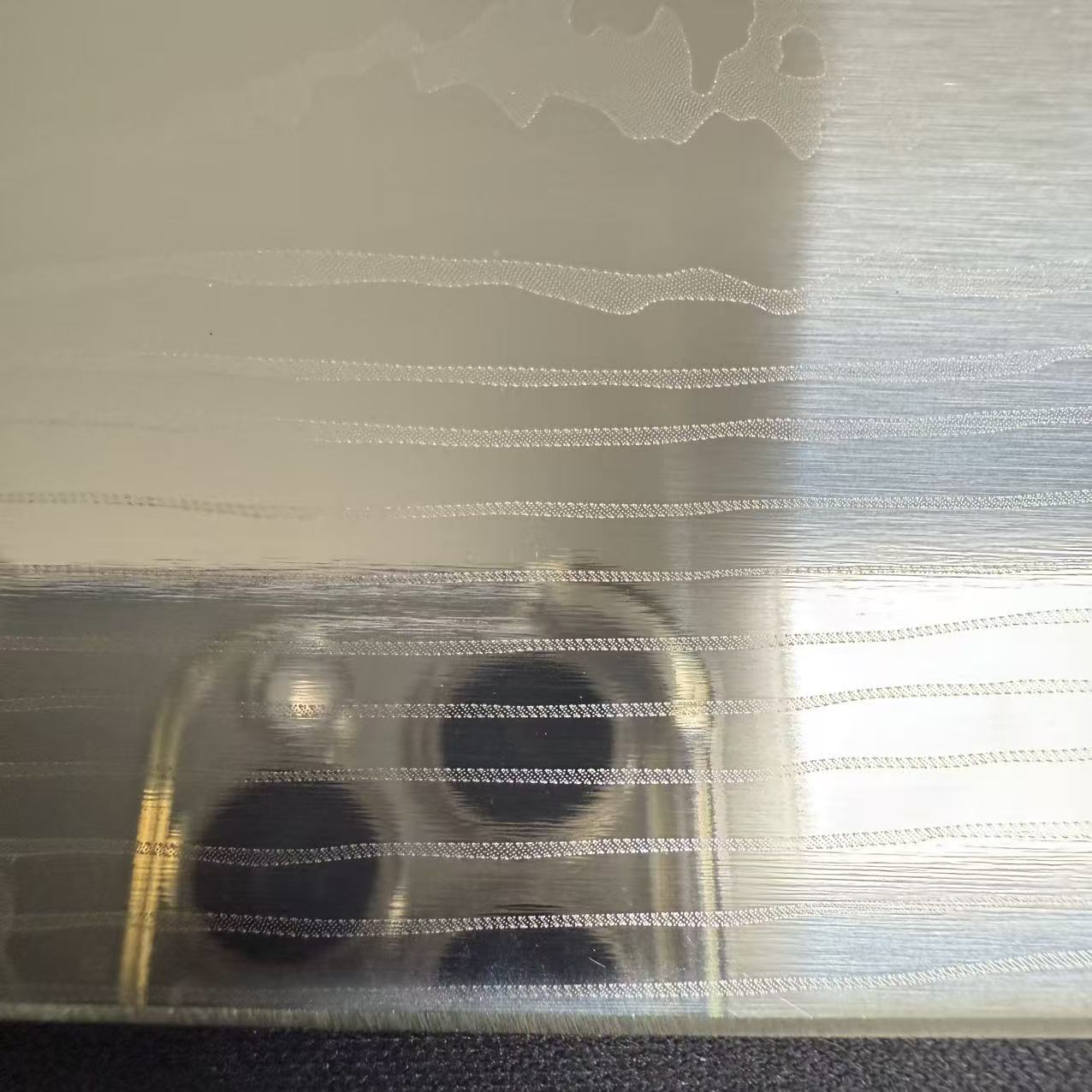
[ A closer look at fake Damascus pattern knife]
The texture is raised and granular, not smooth. Genuine Damascus pattern comes from the steel itself — the different alloys sit flush, and the contrast is revealed through etching, which selectively removes material. Laser engraving does the opposite: it burns material onto or into the surface, leaving a slightly raised, rough texture along each “line.” Under magnification or raking light, you can see this as a fuzzy, granular ridge rather than a clean, sharp boundary between two steels.
The pattern is mechanically regular. A laser engraver follows a programmed path. Every wave, every curve, every repeat is geometrically consistent — because it was drawn in software. Genuine Damascus, even the most refined machine-rolled cladding, has organic variation from the forge-welding process. Hand-folded Damascus has even more. If the pattern looks like it could have been designed in Illustrator and tiled across the blade, it probably was.
Who Makes It and Why
To be fair, not every manufacturer producing these blades is being deceptive. Many budget knife brands make no secret that they produce “pattern Damascus” or “decorative Damascus” and price accordingly. A kitchen knife with a laser-etched pattern at $15–25 can still be a functional tool if the underlying steel is decent and the heat treatment is correct.
The problem is when this product is sold at a premium price with vague language — “Damascus-style,” “Damascus pattern,” or simply “Damascus” in large letters — without disclosure. A buyer who pays $80 for what they believe is a genuine multi-layer Damascus knife and receives a laser-engraved 3Cr13 blade has been misled.
Laser-engraved Damascus is a cosmetic product. It is not a performance product. If the underlying steel is good and the price reflects that, it can be a perfectly usable knife. But it has no structural advantage over any other single-steel blade, and if the engraving is the main selling point, you’re paying for aesthetics that will wear over time.
Type 2: Cladding Steel Damascus — The High-Performance Workhorse
This is what most professional-grade “Damascus” kitchen knives actually are, and when done right, it’s an excellent construction.
Cladding Damascus — also called San Mai or laminated Damascus depending on construction — is a knife made from a high-performance core steel sandwiched between layers of softer, more corrosion-resistant cladding steel. The cladding layers are forge-welded to the core under heat and pressure, then manipulated to create the wavy Damascus pattern visible on the blade’s flat.
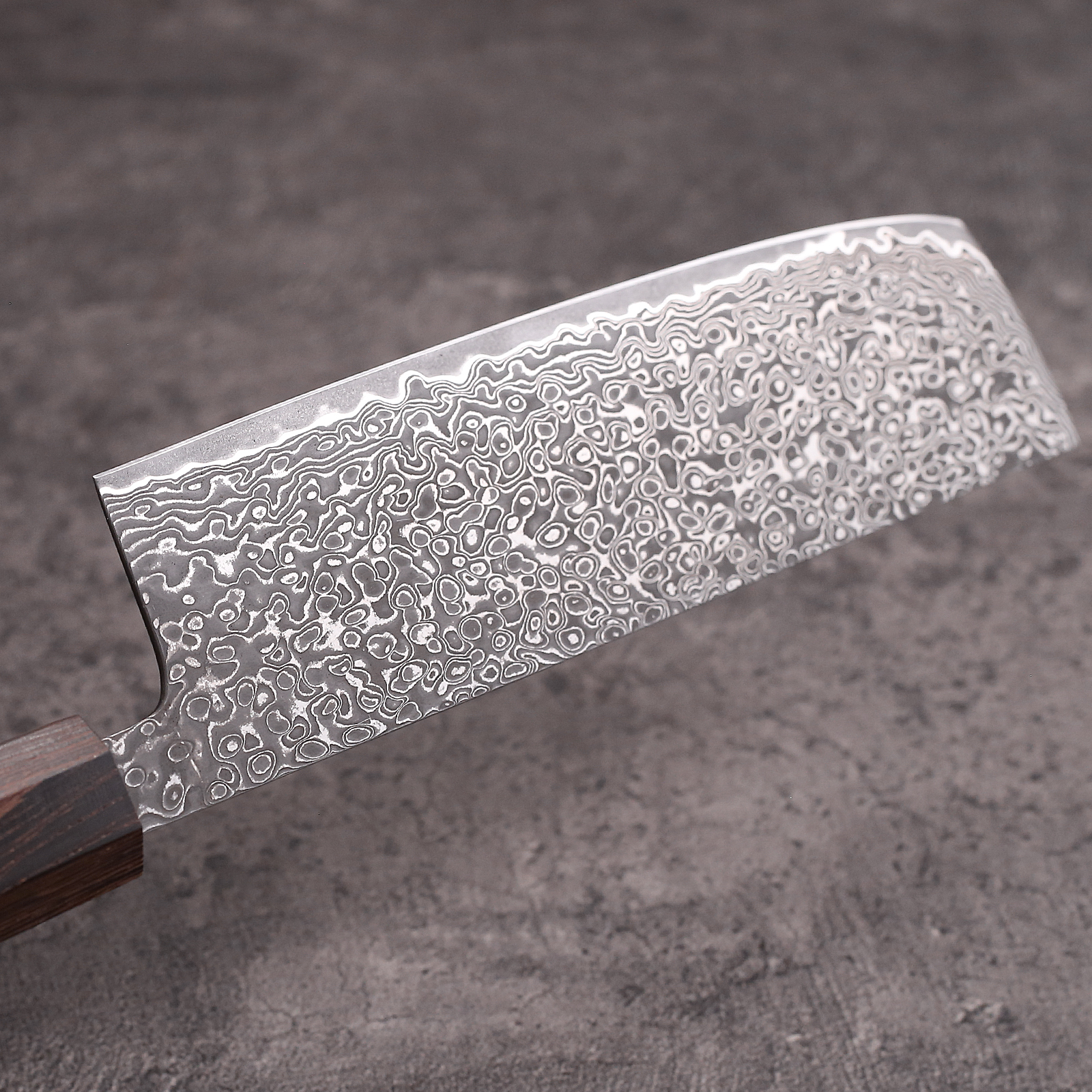
[ A closer look at Damascus cladding * Acid etched finish]
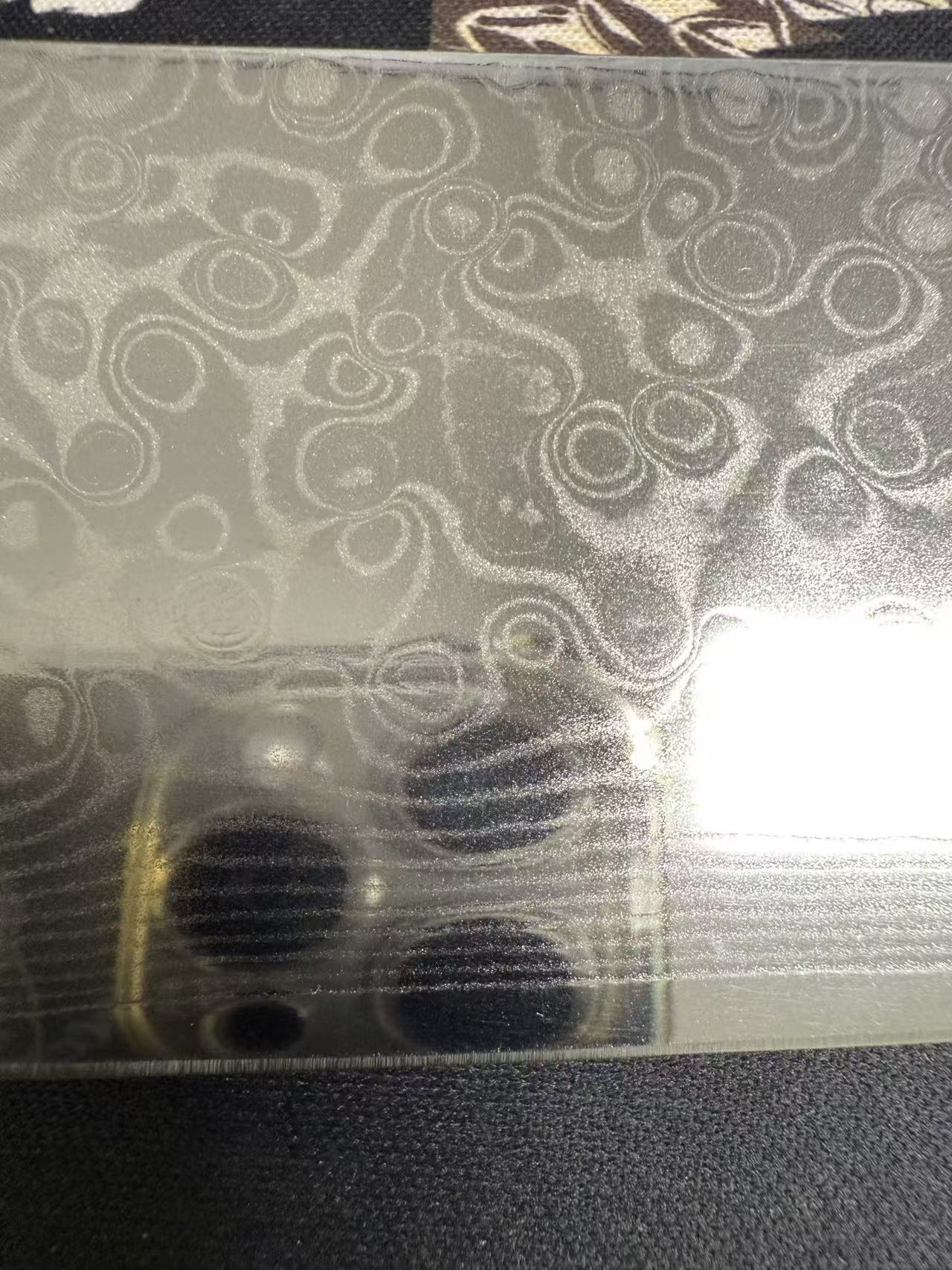
[ A closer look at Damascus cladding * Sand blasting finish]
Common Layer Counts
The layer count you see in product descriptions — 45-layer, 65-layer, 67-layer, 71-layer, 101-layer — refers to the cladding material only. These layers are created by folding and re-welding the cladding steel repeatedly before it’s welded to the core. The math works like this: start with 2 sheets, fold once to get 4, fold again to get 8, and so on. A 64-layer (often called 67-layer counting the 3-layer core separately) cladding package, for example, comes from folding a billet 6 times (2^6 = 64 layers).
More layers mean finer, denser patterning — but beyond a certain point, additional folding has diminishing returns and can actually reduce pattern visibility as layers become too thin.
The Cores That Matter
What actually determines performance in a cladding Damascus knife is the core steel — not the cladding, not the layer count. The cladding is largely decorative and protective. The core is where cutting happens.
Common core steels used in cladding Damascus knives include:
A: 10Cr15CoMoV (often written as 10Cr15) — a Chinese high-carbon stainless steel with a cobalt addition, comparable in many respects to Japanese VG-10. It’s used widely in Chinese Damascus kitchen knives and, when properly heat-treated, achieves Rockwell hardness around 60–62 HRC. Good balance of edge retention and toughness.
B: VG-10 (V Gold 10) — a Japanese stainless steel developed by Takefu Special Steel, and one of the most respected core steels in the cladding Damascus world. High vanadium content (around 1.5%) contributes to excellent edge retention. Typical hardness 60–62 HRC. This is the core steel used in many premium Japanese Damascus knives, including the iconic 67-layer constructions.
C: AUS-10 — another Japanese stainless steel, slightly lower in vanadium than VG-10 but more budget-friendly. A solid mid-tier core steel for cladding Damascus, typically 58–60 HRC.
D: M390 — a premium Austrian Böhler-Uddeholm powder metallurgy steel with exceptional edge retention, corrosion resistance, and hardness potential (62–64 HRC). When used as a core in Damascus cladding, it produces a high-end knife with outstanding performance. Naturally commands a higher price.
What the Cladding Actually Does — And What It Doesn’t
This is a point worth being blunt about: the cladding layers contribute nothing to cutting performance. Zero. The Damascus pattern on a cladding knife is beautiful, and it is structural in the sense that the layers are real forge-welded steel — but they exist entirely above the cutting edge. The cladding meets the bevel on either side and stops. Only the core steel is exposed at the very edge where cutting actually happens.
The softer outer layers do serve some real functional purposes — just not the ones most marketing copy implies:
1. They protect the hard, sometimes brittle core steel from lateral stress and side impact
2. They improve corrosion resistance around the core (many high-carbon core steels are more reactive to moisture and acids)
3. They create the visual Damascus pattern after acid etching
4. Their softer surface makes the flat of the blade easier to maintain on a whetstone without damaging the hard core
But if you remove the cladding entirely and leave only the core, the knife would cut identically. The cladding is functional packaging — and aesthetically extraordinary packaging — around a core that does all the actual work.
This means layer count in a cladding Damascus knife is almost entirely a visual specification. A 45-layer cladding and a 71-layer cladding around the same VG-10 core will perform the same at the edge. The difference is only in how fine and dense the surface pattern appears.
Identifying Genuine Cladding Damascus
On a genuine cladding Damascus blade, the pattern extends all the way to the edge bevel and in many cases you can see where the softer cladding layers meet the harder core at the very edge line. Etch the blade in ferric chloride solution and the contrast becomes even clearer — the high-carbon core darkens more aggressively than the cladding.
The pattern should also have slight organic variation. Even though cladding Damascus is machine-produced in most cases, the forge-welding and pattern manipulation introduce natural irregularity. A completely symmetrical, repeating pattern is suspicious.
Cladding Damascus is a legitimate and high-performing knife construction. The layer count is largely cosmetic; what matters is the core steel identity and its heat treatment. A 67-layer VG-10 core knife from a reputable manufacturer is an excellent kitchen knife by any measure. Know your core steel, confirm the hardness specification, and you’re buying a real product with real performance credentials.
Type 3: Hand-Folded Damascus — True Pattern Steel
This is what the word “Damascus” originally meant in the modern knife world (the historical Wootz Damascus is a separate tradition entirely), and it remains the pinnacle of the craft.
Hand-folded Damascus — also called pattern-welded Damascus or forge-welded Damascus — is made by forge-welding two or more different steels together into a billet, then repeatedly folding, drawing out, and re-welding the billet to multiply the layers. The bladesmith then manipulates the billet — twisting, pressing, grinding — to create the final visible pattern before forging the blade profile and grinding to shape.
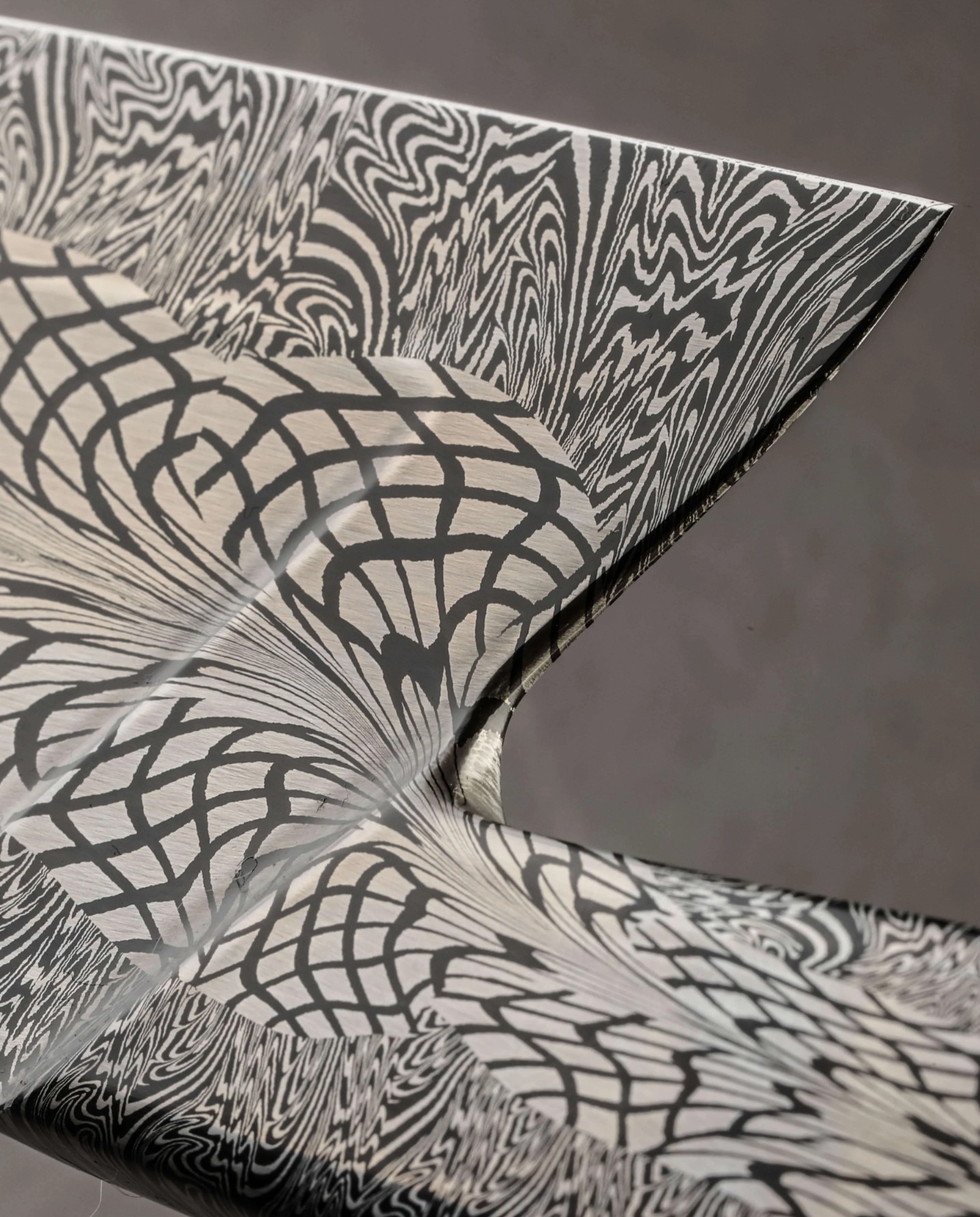
Crucially: there is no separate core. In a hand-folded Damascus billet, every layer runs through the entire blade, including the edge. The pattern is structural, not decorative. When you look at the edge of a hand-folded Damascus blade and see the pattern continuing all the way to the very tip of the cutting edge, that’s not an illusion — the different steel layers are literally there, exposed and functional.
Common Steel Pairings
Traditional hand-folded Damascus typically uses two steels with contrasting carbon content and etching response to maximize visual contrast:
1075 + 15N20: One of the most popular combinations. 15N20 contains nickel, which resists acid etching and stays bright silver, while 1075 (a plain high-carbon steel) darkens dramatically. The contrast creates the classic light-and-dark flowing pattern. Both are high-carbon steels that harden well, so edge performance is excellent.
1084 + 15N20: Similar to above; 1084 is slightly higher carbon, producing a harder edge while still being forgiving enough for beginners to forge.
52100 + 15N20: A premium pairing. 52100 is a bearing steel with excellent wear resistance and toughness, creating a very high-performing Damascus when paired with 15N20.
O1 + L6: A classic combination used by many American bladesmiths. O1 is an oil-hardening tool steel; L6 is a tough, nickel-containing die steel. Both are high performers.
These steels are all high-carbon, non-stainless alloys. This is an important point.
Not all handmade Damascus steel is good steel. If poor-quality steel is used, even though folding creates patterns, the performance will still be very poor. Pakistani steel often has these problems.
In fact, hand forging completely depends on the steel chosen by the maker. For example, if aluminum is used to make a Damascus blank, the forged result is purely decorative. Such materials are applied in things like smartphone frames, audio equipment, or golf club handles. The hardness is far too low, with no cutting performance — it’s only ornamental.
Side-by-Side Summary
| Feature | Laser-Engraved Damascus | Cladding Damascus | Hand-Folded Damascus |
|---|---|---|---|
| Pattern type | Surface decoration only | Structural (cladding layers) | Structural (full billet) |
| Core / billet material | Single steel throughout | VG-10, 10Cr15, AUS-10, M390, etc. | Blended billet (e.g. 1084 + 15N20) |
| Cladding contributes to cutting? | N/A | No — core only | No separate cladding |
| Layer count | N/A (engraved) | 45 / 65 / 67 / 71 / 101+ | 100–300+ typical |
| Typical hardness | Depends on base steel | 60–64 HRC (core-driven) | ~58–60 HRC (billet average) |
| Edge retention | Low–medium | High | Medium–high |
| Toughness | Medium | Medium (hard core can chip) | Higher (blended billet) |
| Corrosion resistance | Depends on base steel | High (stainless core + cladding) | Lower (carbon steel) |
| Pattern uniqueness | None (identical every knife) | Limited (production tooling) | High (each billet unique) |
| Typical price range | $15–60 | $60–400+ | $200–1,000+ |
| Care requirement | Standard | Standard | Higher (carbon steel) |
The Honest Buyer’s Guide
Before purchasing a Damascus knife, ask three questions:
1. What is the core steel, or what steels make up the billet? Any reputable seller of genuine Damascus can answer this immediately. “Damascus steel” is not a steel type — it’s a construction method. The actual alloy matters.
2. What is the Rockwell hardness? Genuine high-performance Damascus — whether cladding or hand-folded — will have a measurable hardness specification. A seller who can’t give you HRC numbers for their core steel or billet is selling you on aesthetics, not performance.
WCK store is focus on Damascus cladding steel knives strikes a practical balance between affordability and performance. By keeping prices accessible while ensuring decent cutting ability, WCK makes Damascus knives attainable for a wider audience without sacrificing core functionality. Their production model also allows for manageable high‑volume output, meaning buyers can rely on consistent supply as well as reliable quality. For anyone seeking Damascus knives that deliver both value and usability, WCK stands out as a smart, dependable choice.
