

Chef's Knives
The Professional Knife Set Buying Guide: Why the San-Mai Ebony Series Covers Every Cut in the Kitchen
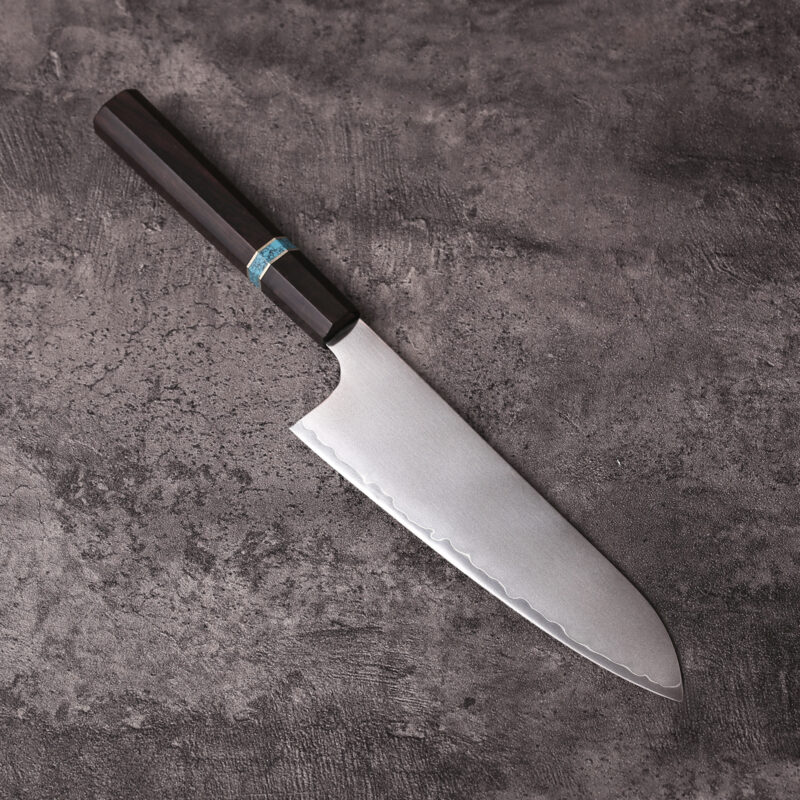
Jun
Every chef has an opinion on knife sets. Most of those opinions boil down to the same thing — buy fewer, better knives. The problem is that “better” means different things depending on what you are cutting, how long you are cutting it, and what you expect the blade to feel like ten thousand cuts later.
This guide breaks down what a professional knife set actually needs to contain, what separates a serious blade from a display piece, why San-Mai steel has become the construction standard that professional buyers keep coming back to, and why knife weight matters more than most buyers realise until they have spent four hours on a prep station.
Why San-Mai Steel?
San-Mai means three layers. A hard high-carbon steel core — the cutting edge — is bonded between two outer layers of softer cladding steel. This construction solves the central problem in blade metallurgy: hard steel cuts well but chips under stress, while soft steel resists chips but dulls quickly.
San-Mai gives you both. The core reaches 59±1 HRC — hard enough for exceptional edge retention through heavy commercial use. The soft cladding absorbs lateral stress and impact without transferring it to the edge. The result is a blade that sharpens quickly, holds its edge through a full service, and survives the kind of daily stress that a single-steel blade at the same hardness level would not.
This construction is also why these knives are light. There is no excess steel. The cladding layers do their job without adding unnecessary mass — which is why the utility knife sits at 101g, the santoku at 148g, and even the flagship 8.2″ kiritsuke comes in at just 164g. In a professional kitchen where a chef may be on the prep station for four to six hours at a stretch, that weight difference is not a small thing. A lighter knife means less wrist load on every single cut — and over thousands of cuts in a shift, that adds up to real fatigue reduction and better precision at the end of service when it matters most.
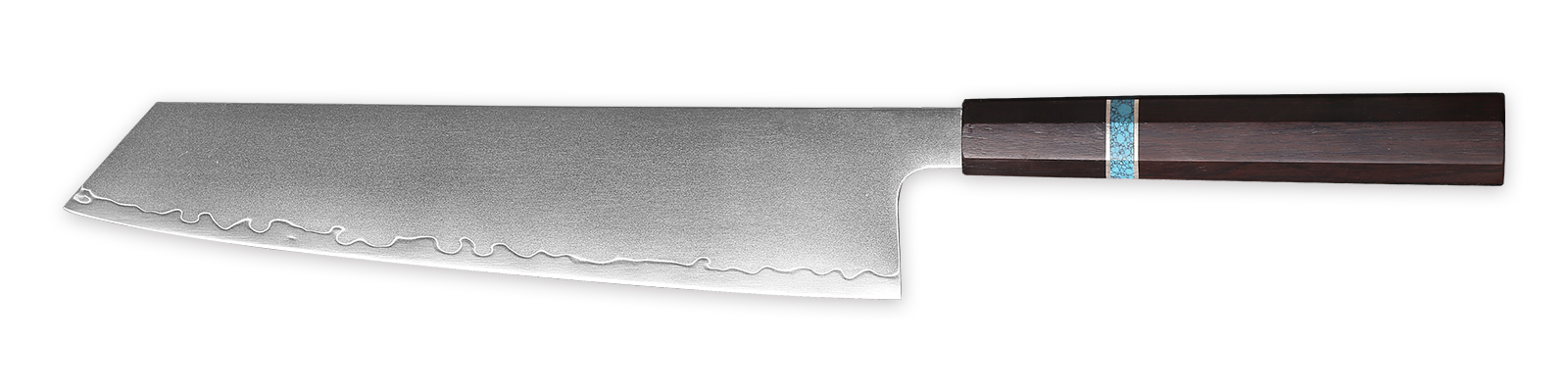
San-Mai is also what gives these blades their characteristic surface texture — the soft outer layers are finished to show the layered cladding line, creating the visual pattern visible across each blade in this series. That pattern is not decorative. It is a direct result of the construction method and a mark that the blade was built the right way.
Why Knife Weight Matters More Than Most Buyers Realise
There is a reason professional chefs who work long shifts gravitate toward lighter, well-balanced knives. A heavy knife feels impressive in the hand for the first ten minutes. By hour three it becomes a liability.
The San-Mai Ebony Series was designed with this in mind. The five knives range from 101g to 174g — intentionally light for their blade lengths. For context, many Western-style chef knives of comparable length run 220g to 280g or more. That difference of 60g to 100g per knife sounds small. Multiply it across thousands of cuts in a single shift and it translates directly into wrist fatigue, grip pressure, and precision loss toward the end of service.
This is particularly relevant for three groups of buyers:
Restaurant and hotel kitchens where prep staff are on their feet for extended periods and knife fatigue is a real operational issue — not just a comfort consideration. A lighter knife set reduces the cumulative strain on prep staff across a full service, which shows up in output quality and injury reduction over time.
Culinary schools where students are learning proper grip and technique. A lighter, balanced knife teaches correct form. A heavy knife teaches compensation — and compensated grip habits are hard to unlearn. Instructors who care about student development specify lighter knives for this reason.
Knife retailers whose customers include serious home cooks who prepare elaborate meals over several hours. The feedback on weight and balance is one of the first things an experienced home cook notices — and talks about. A knife that feels right after two hours of prep is a knife that gets recommended.
The lighter knife tradition has always understood this principle. Lighter steel, better geometry, sharper edge — less force required on every cut, less strain accumulated over time. The San-Mai Ebony Series brings that principle to a wholesale price point without compromising on construction standard. You are not getting a lighter knife because corners were cut. You are getting a lighter knife because the construction method does not require unnecessary mass to achieve the hardness and edge retention the blade needs.
Breaking Down the San-Mai Ebony Series
The San-Mai Ebony Series covers the complete five-role framework of professional kitchen prep. Here is how each knife maps to its role and what the specs mean in practice:
[5.5″ Utility Knife] — 142mm blade, 101g
The lightest knife in the series and the one that stays in hand the most. At 32mm wide and 101g, it is compact enough for detail cuts and precise enough for tasks that demand close-range control — trimming, peeling, cleaning proteins, breaking down small produce. The 59±1 HRC core hardness means the edge holds even through the repetitive small cuts that utility work demands. When fatigue-free handling matters most, this is the knife that delivers it — at 101g it almost disappears in the hand during extended fine prep.
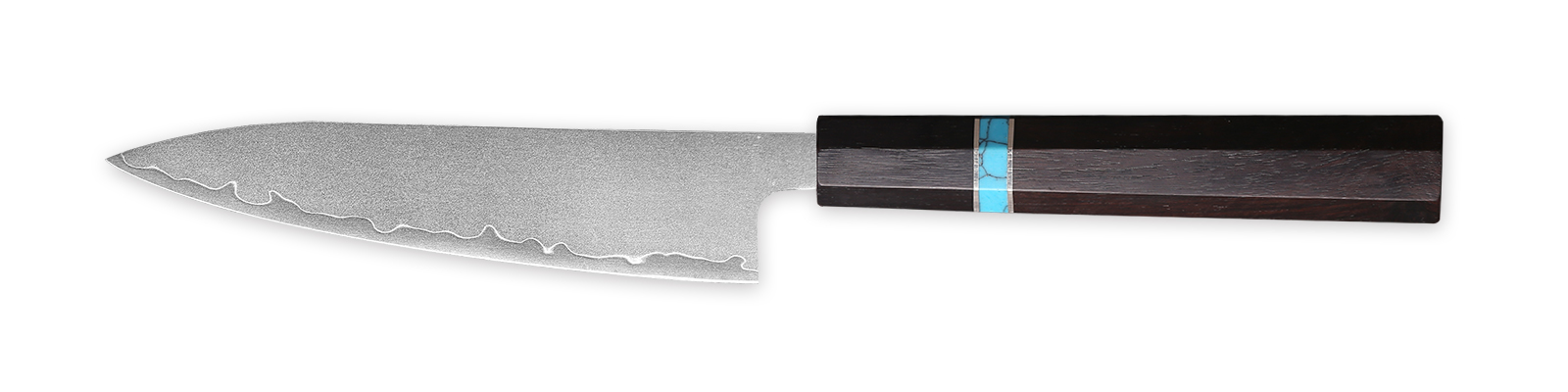
[6″ Honesuki] — 150mm blade, 111g
Narrow at 39mm and stiff through the blade. Built for directional cuts around bone and joint — breaking down whole poultry, navigating around joints, following the contour of a carcass without the blade wandering. The weight is low enough to maintain precise control during the angled, close-contact cuts that honesuki work demands. At 111g it is light enough to use for extended butchery sessions without the wrist fatigue that heavier boning knives produce. Wrong pressure in the wrong direction and you lose the line — this knife is designed to hold it.
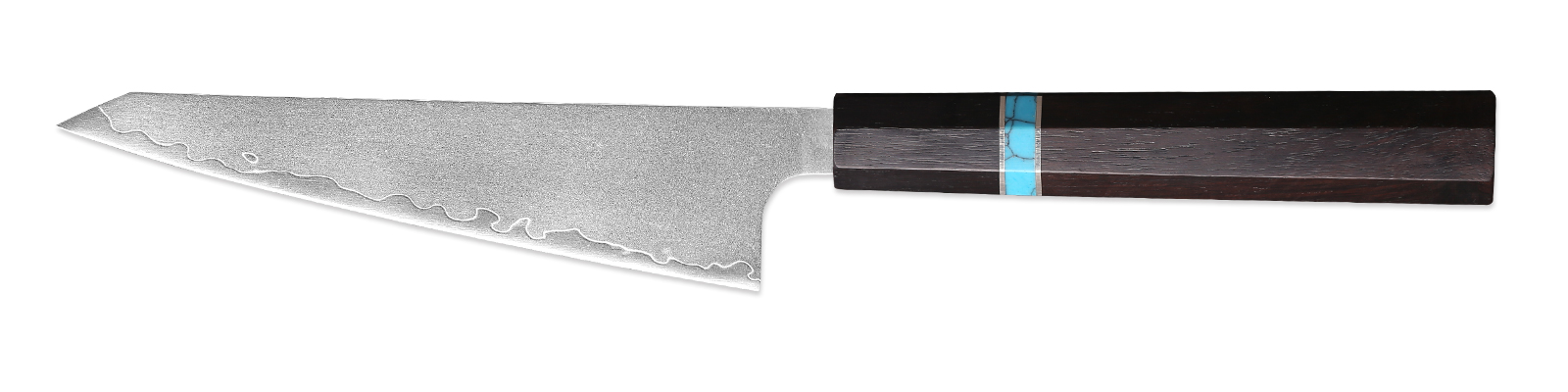
[6.5″ Nakiri] — 170mm blade, 174g
The widest blade in the series at 50mm and the heaviest at 174g. Both of those numbers are features, not compromises. The width keeps the full edge in contact with the board through the down stroke, eliminating the rocking and pulling that slower vegetable work with a general-purpose knife requires. The weight lets gravity assist through dense root vegetables — less force from the wrist, cleaner cuts, faster throughput. For high-volume vegetable prep stations, a nakiri at this spec is a significant efficiency upgrade over using a santoku or chef knife for the same work.
[7″ Santoku] — 180mm blade, 148g
The balance point of the series and the knife that sees the most use in most professional kitchens. At 48mm wide and 148g, it handles meat, fish, and vegetables without switching blades — the knife a chef reaches for when the task does not call for something more specialised. At 148g it is light enough to use across a full service without wrist fatigue, and the 180mm blade length covers most prep tasks in a single stroke. This is the knife that earns its place by being the right answer most of the time.
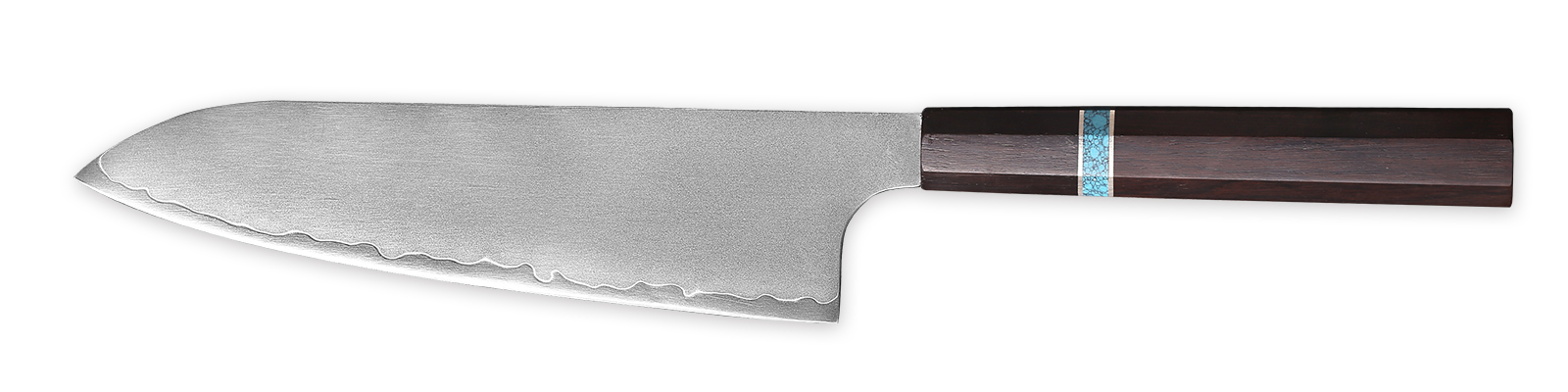
[8.2″ Kiritsuke] — 210mm blade, 164g
The flagship of the series and the longest blade at 210mm. Built for the long slicing draws through fish and proteins that shorter blades cannot complete cleanly in a single stroke, and for the kind of precise, controlled vegetable cuts that define skilled prep work. At 164g it is remarkably light for a blade of this length — most Western chef knives at 210mm run considerably heavier. That weight reduction is the direct result of San-Mai construction: the blade achieves its hardness through steel quality rather than steel mass. In experienced hands it is the most capable knife in the set and the one that communicates the quality of the full series at a glance.
Who Is This Set For?
The San-Mai Ebony Series is built for professional buyers — knife retailers, restaurant suppliers, culinary schools, hotel kitchen procurement, and subscription box operators who need a knife set that holds up to the scrutiny of professional end users.
The weight profile of this series is a deliberate selling point. At 101g to 174g across five blades, these are knives designed for all-day use without wrist fatigue — a specification that matters deeply to restaurant buyers managing staff welfare and output across long services, and to retailers whose customers cook seriously and notice the difference between a knife that works with the hand and one that fights it.
The construction standard — San-Mai steel, 59±1 HRC core hardness, consistent handle geometry across five blades — is specified at the level that professional buyers recognise and trust. The visual design — ebony wood, turquoise inlay, matching across all five — makes the set work equally well as a display product and as a working kitchen tool that earns its place on a prep station.
For buyers looking to add their own brand, all five knives are available with custom logo engraving, OEM packaging, and private label options. Handle material can be customized across the set — ebony wood, olive wood, rosewood, or pakka wood. Mixed handle options across the five knives in a single order are also available.
The Complete San-Mai Ebony Series at a Glance
| Knife | Blade | Total Length | Blade Width | Weight |
|---|---|---|---|---|
| [Utility 5.5″] | 142mm | 285mm | 32mm | 101g |
| [Honesuki 6″] | 150mm | 300mm | 39mm | 111g |
| [Nakiri 6.5″] | 170mm | 325mm | 50mm | 174g |
| [Santoku 7″] | 180mm | 330mm | 48mm | 148g |
| [Kiritsuke 8.2″] | 210mm | 360mm | 47mm | 164g |
All knives: San-Mai 3-Layer Composite Steel · Core hardness 59±1 HRC · 2.0mm blade thickness · Ebony Wood + Turquoise handle (default)
Frequently Asked Questions
What is San-Mai steel and why does it matter for professional knives?
San-Mai is a three-layer blade construction — a hard steel cutting core bonded between two layers of softer cladding steel. The core provides sharpness and edge retention at 59±1 HRC. The cladding absorbs shock and prevents brittleness. For professional use, the result is a blade that sharpens easily, holds its edge through heavy commercial use, and resists chipping under the stress of a busy prep station.
Why are these knives lighter than most Western chef knives?
San-Mai construction achieves high hardness through steel quality rather than steel mass. The cladding layers do not add unnecessary weight — they add toughness. This is why the full San-Mai Ebony Series ranges from 101g to 174g across five blade lengths from 142mm to 210mm. Lighter knives reduce wrist fatigue over extended prep sessions, which is why professional chefs who work long shifts consistently prefer them over heavier Western-style blades.
What knives are included in the San-Mai Ebony Series?
The series includes five knives covering the complete range of professional kitchen prep: a 5.5″ utility knife, 6″ honesuki, 6.5″ nakiri, 7″ santoku, and 8.2″ kiritsuke. All five share the same San-Mai steel construction, 59±1 HRC core hardness, and ebony wood with turquoise handle.
Is custom branding available on the full set?
Yes — logo engraving, OEM packaging, and private label are available for individual knives or the complete set. Handle material can also be customized across the series — ebony wood, olive wood, rosewood, or pakka wood. Mixed handle options across the five knives in a single order are available on request.
What is the minimum order quantity for wholesale?
Contact Joseph at 9862098879 to discuss minimum order quantities, set pricing, samples, and custom branding requirements.
Which knife in the series is best for a chef working long prep shifts?
All five knives in the San-Mai Ebony Series are designed with extended use in mind. For general all-day prep the 7″ santoku at 148g is the most versatile and the lightest option for its blade length. For detail work the 5.5″ utility at 101g produces the least wrist strain of any knife in the series. For protein and fish work the 8.2″ kiritsuke at 164g delivers flagship performance at a weight that most comparable Western chef knives at the same length cannot match.
Build Your Set
Available individually or as a complete five-piece set. Custom branding, handle options, and combo orders welcome.
[5.5″ Utility Knife] · [6″ Honesuki] · [6.5″ Nakiri] · [7″ Santoku] · [8.2″ Kiritsuke] · [Full 5-Piece Set]
Contact Joseph: 9862098879
