

Chef's Knives
Copper Mai Damascus Knife Blanks Wholesale
Jun
Copper Mai Damascus knife blanks: wholesale buying guide
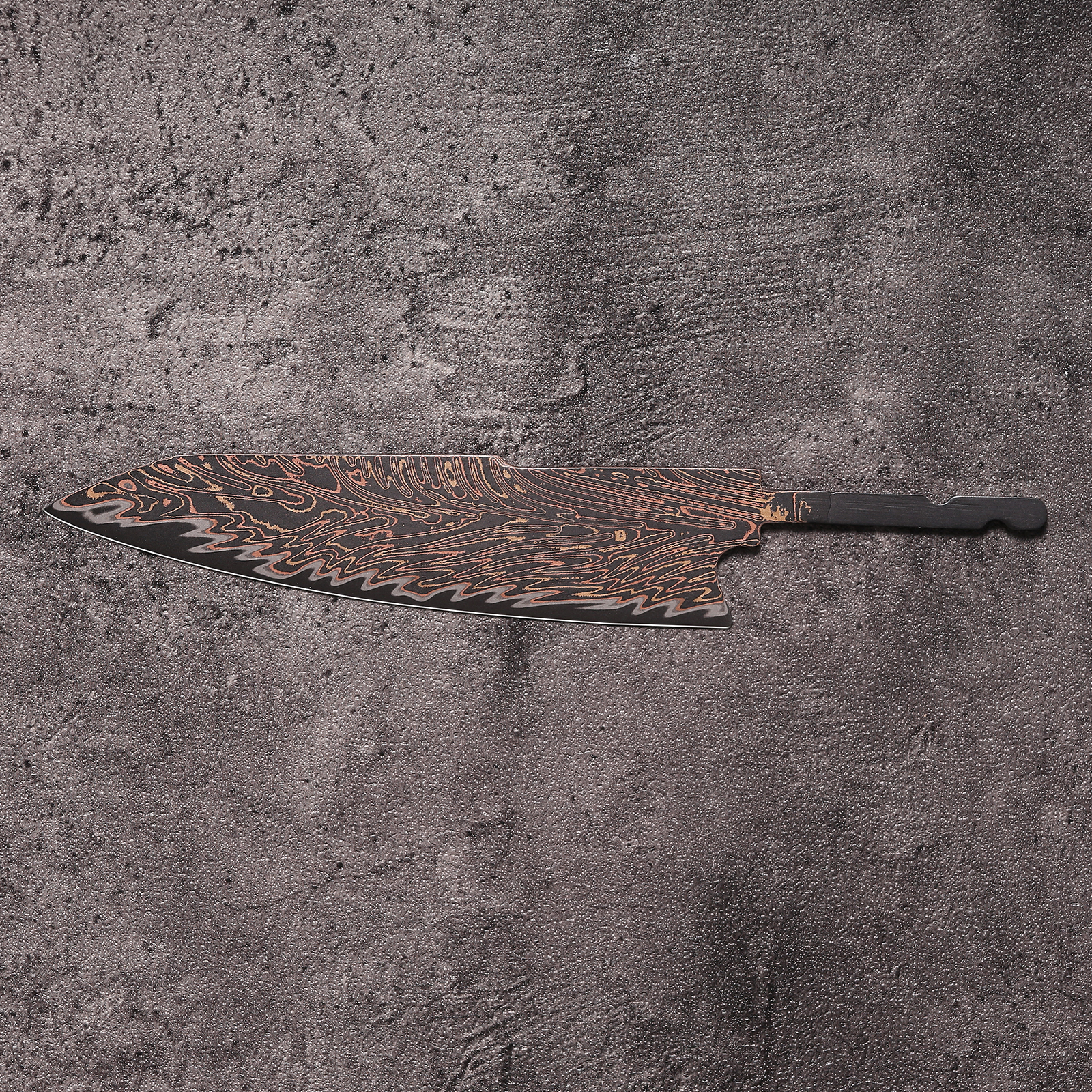
Copper Mai Damascus is the most visually distinctive knife blank material in our range — and one of the rarest in the wholesale market. Standard Damascus uses alternating layers of high-carbon and stainless steel. Copper Mai adds copper into the layered construction, producing a warm metallic shimmer that appears between the dark and bright layers of the Damascus pattern when light hits the blade.
No two copper mai blanks look identical. The copper integrates differently through the folding and forge-welding process, producing a pattern that is unique to each blade — feathered, swirling, or rippling, depending on how the billet was worked. At wholesalechefknife.com we carry copper mai blanks in two distinct pattern styles: feather pattern and swirl pattern.
Both are built on a VG10 stainless cutting core, heat treated to HRC 59±, and supplied ready for handle fitting. Factory-direct pricing — no agents, no importers between our production facility and your order.
1. What is Copper Mai Damascus steel?
To understand Copper Mai, it helps to start with standard Damascus — then understand what changes when copper is added.
Standard Damascus steel — steel layers only
Standard Damascus (pattern-welded steel) is produced by forge-welding alternating layers of two steel types — typically a high-carbon steel and a stainless or nickel-bearing steel. After welding, drawing, and folding, the billet is ground and acid-etched. The etch reacts differently with each steel type, revealing the flowing grain pattern. The result is a blade with a dark-and-bright ripple pattern across the full blade face.
Copper Mai — copper added to the Damascus construction
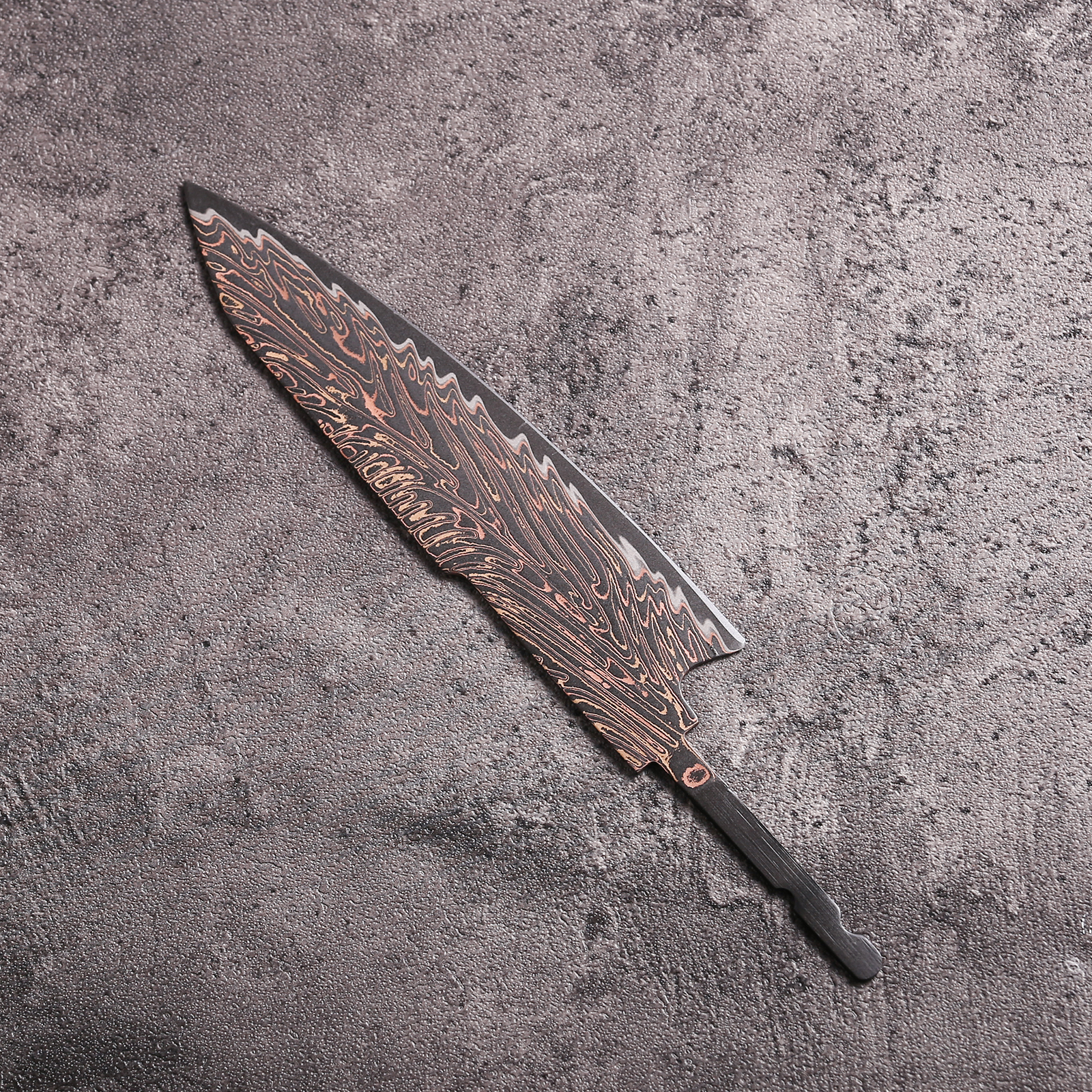
Copper Mai takes this process further. Copper is incorporated into the layered billet alongside the steel layers. When the billet is forge-welded, drawn, and folded, the copper integrates between the steel layers. When the blade is ground and etched, the copper appears as warm golden or reddish-bronze highlights within the Damascus pattern — a colour and shimmer that no steel-only construction can produce.
The word “Mai” (枚) is Japanese, meaning “layer” or “sheet.” Copper Mai — copper layer — describes the construction accurately: copper layers within the Damascus billet.
Is the copper structural or decorative?
The copper in a Copper Mai blade is part of the blade’s metallurgical construction — it is forge-welded into the billet, not plated or applied to the surface. This means the copper shimmer you see on the blade face is genuine metallic copper within the blade material, not a coating or finish.
The cutting edge is formed from the VG10 steel core — copper does not contribute to the cutting performance. The copper’s role is in the cladding layers that surround the core. The result is a blade that cuts like a quality VG10 knife and looks like nothing else available at this price point.
2. Feather pattern vs swirl pattern — what is the difference?
We carry copper mai blanks in two distinct visual patterns. The steel and core specification is the same for both — the difference is in how the billet was worked during forging, which produces a different grain pattern in the finished blade.
Feather pattern
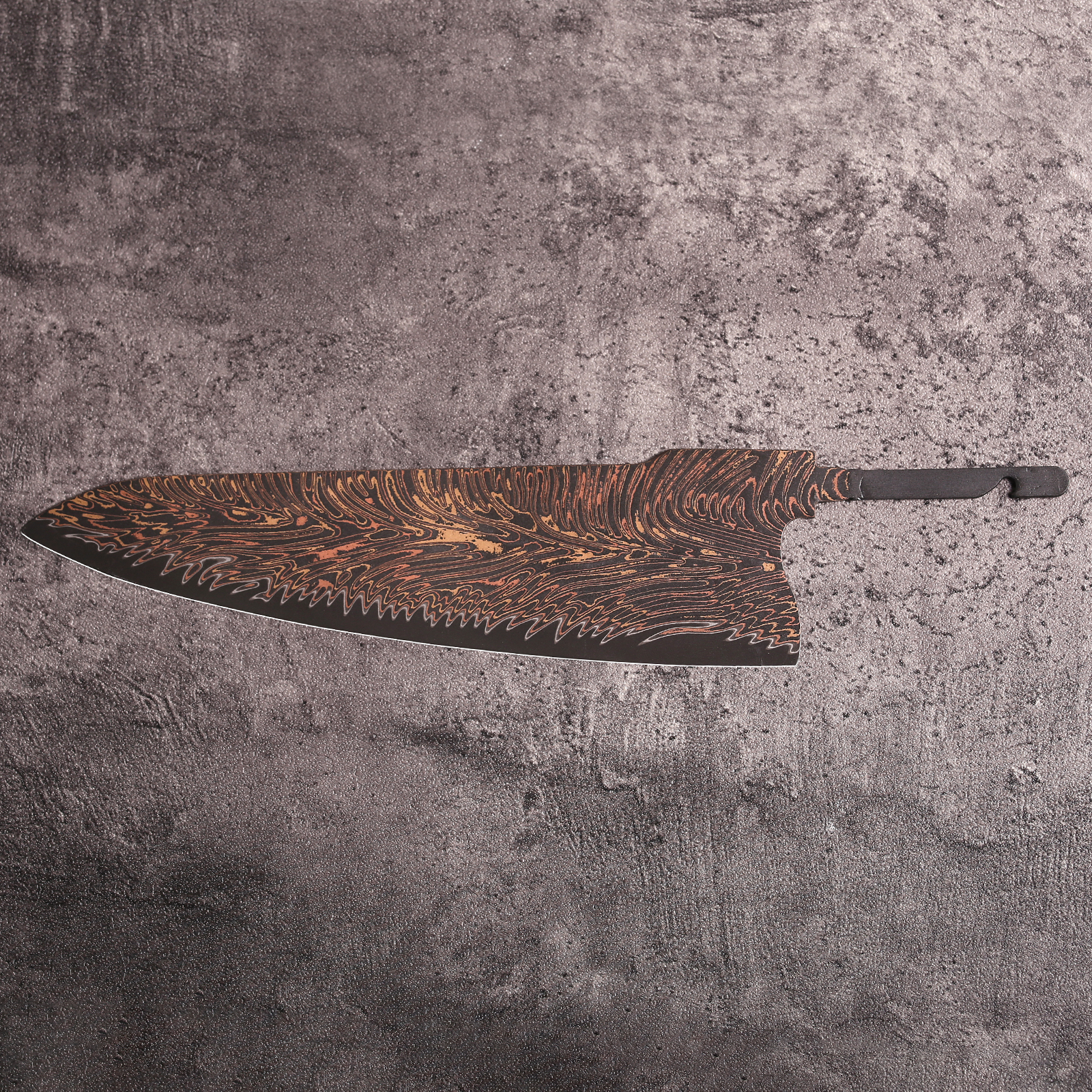
The feather pattern is produced by a specific manipulation of the layered billet during forging — the layers are cut and restacked at an angle before welding, then the surface is worked to produce a fine, branching grain that resembles the structure of a feather or fern leaf. The copper within the billet appears as warm highlights running along the feather lines.
The feather pattern is the more intricate and detailed of the two. Under direct light, the fine branching structure catches light differently across the blade face, creating a dynamic visual that changes as the blade moves. This is the pattern that photographs most dramatically for product listings and social media.
Swirl pattern
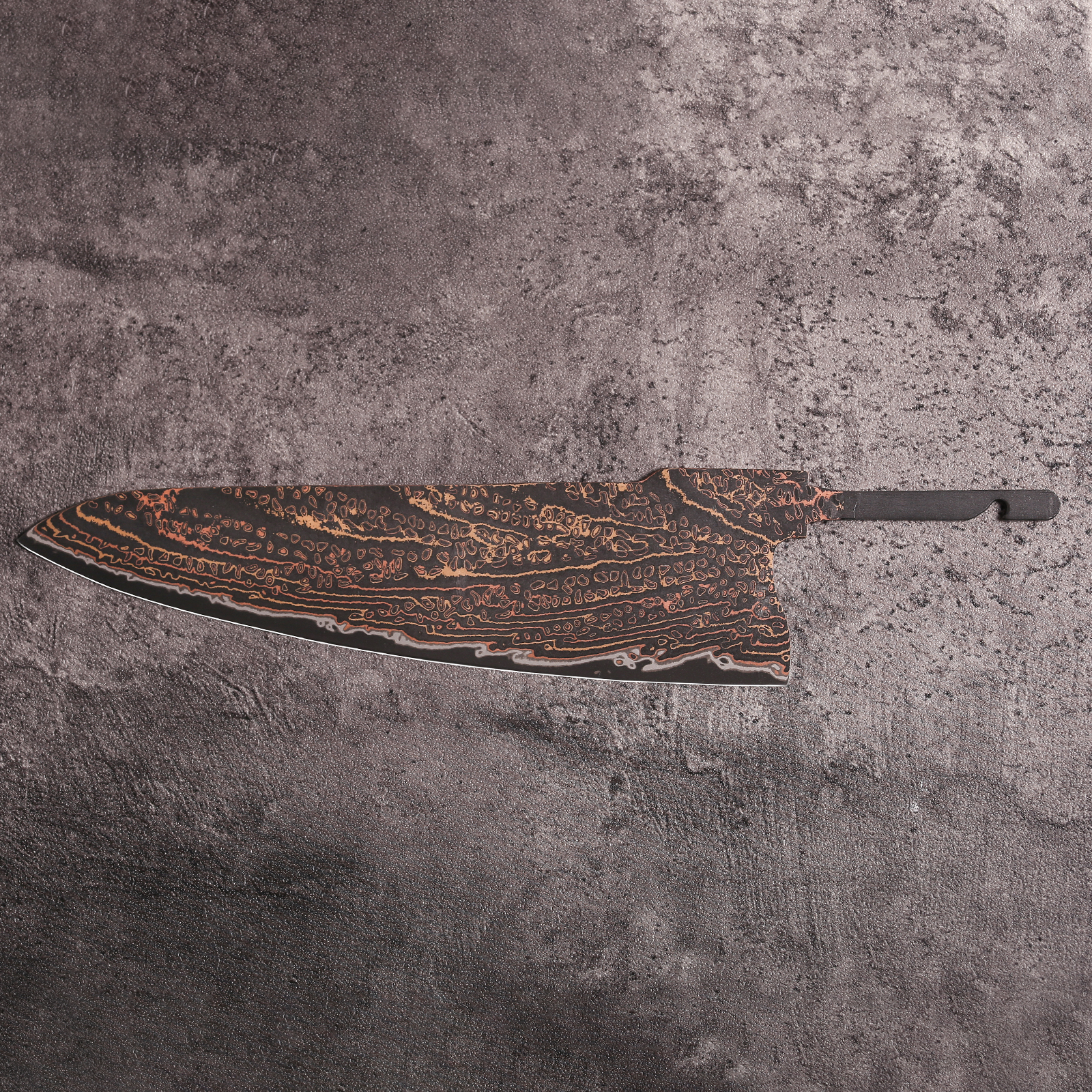
The swirl pattern is produced by a twisting manipulation of the billet — the layered steel and copper billet is twisted during the forging process, producing a flowing, circular grain that swirls across the blade face. The copper appears as warm spiral highlights within the swirling Damascus grain.
The swirl pattern has a more organic, flowing quality compared with the precision of the feather pattern. It appeals to buyers who want a bold, statement visual rather than a detailed intricate one. Both patterns are equally distinctive — the choice between them comes down to the aesthetic direction of the knife line or the preference of the end buyer.
Natural variation — every blank is unique
Because copper integrates differently through the forging process on each individual blank, no two copper mai blanks — even from the same batch and the same pattern style — are exactly identical. The copper shimmer appears in slightly different positions, intensities, and distributions on each blade.
For custom knife makers, this is a genuine selling point to end buyers: every copper mai knife is, in a meaningful sense, one of a kind. This is a story that sells at premium retail prices.
3. Copper Mai blanks we stock — confirmed specifications
| Profile | Pattern | Blade length | Weight | Core steel | HRC | Bevel | Price | Buy |
|---|---|---|---|---|---|---|---|---|
| Chef knife blank | Feather pattern | 200mm | approx. 97g | VG10 stainless | 59± | Double-edged | $59.90 -33% | Buy now |
| Chef knife blank | Swirl pattern | 200mm | — | VG10 stainless | 59± | Double-edged | $59.90 -33% | Buy now |
| Petty knife blank | Copper Damascus | 125mm | — | Copper Damascus | — | Double-edged | $49.90 -38% | Buy now |
| Other profiles | Copper Mai | Custom | — | VG10 stainless | 59± | Double-edged | On enquiry | Enquire |
All copper mai blanks: VG10 stainless core (chef knife blanks), copper forge-welded into Damascus cladding layers, heat treated, ground and ready for handle fitting. — marks: spec not listed on current product page — contact Joseph to confirm. Other profiles (nakiri, kiritsuke, santoku, gyuto) available on volume OEM enquiry.
4. Steel specifications — VG10 core, HRC 59±
Cutting core — VG10 stainless steel
The cutting edge on all our copper mai blanks is formed from a VG10 stainless steel core. VG10 (V Gold No. 10) is produced by Takefu Special Steel in Japan and is one of the most respected steels in production kitchen knife manufacturing.
• Hardness: HRC 59± — confirmed on our feather pattern chef blank; consistent across the copper mai range
• Carbon: approximately 1% — provides strong edge retention
• Chromium: approximately 15% — fully stainless, will not rust under normal kitchen use
• Cobalt: approximately 1.5% — improves hardenability and long-term edge stability
• Sharpening: responds well to ceramic and waterstone sharpening at 1000–3000 grit for reprofiling, 6000–8000 grit for a polished edge
• Maintenance: stainless — no reactive steel patina management required. Suitable for retail lines where stainless performance is a requirement
A note on HRC 59± vs standard Damascus HRC 60–62
You may notice that our copper mai blanks are specified at HRC 59±, slightly lower than our standard Damascus blanks at HRC 60–62. This is a deliberate and honest specification. The copper in the billet affects the overall heat treatment dynamics of the blade — a slightly lower target hardness is used to maintain toughness and prevent brittleness at the blade edge given the mixed-metal construction.
The HRC 59± vs 60–62 — the reason is technical and correct: copper has a lower melting point than steel (copper melts at approximately 1085°C, steel at 1370–1510°C). So during heat treatment, the temperature and process must be set more gently to avoid damaging the copper layers. The result is a slightly lower target HRC — but not inferior performance.
At HRC 59, the blade is still significantly harder than most European stainless kitchen knives (typically HRC 56–58) and delivers strong edge retention and sharpening performance. The visual uniqueness of the copper mai construction far outweighs the marginal hardness difference for the artisan and premium retail markets this blank serves.
Cladding — Copper Mai Damascus
The cladding layers surrounding the VG10 core contain the Damascus steel and copper construction that produces the blade’s visual pattern. The copper is forge-welded into the cladding billet — it is metallurgically bonded to the steel layers, not plated or applied as a surface treatment.
Supply state: ground, pattern revealed, ready for handle fitting — no further blade work required before fitting handles.
5. Why copper mai commands premium retail prices?
Copper mai blanks are priced above standard Damascus blanks — and finished knives built on copper mai blanks consistently retail at the highest prices of any knife in their category. Here is why.
It is genuinely rare
Standard Damascus knife blanks are widely available from dozens of suppliers globally. Copper mai blanks are not. The additional complexity of incorporating copper into the forge-welding process, and the higher rate of pattern inconsistency that must be screened in quality control, means fewer suppliers produce copper mai blanks to a consistent standard.
When your customers see a copper mai knife on a retail shelf or product listing, they are unlikely to have seen one before. Rarity is one of the most powerful drivers of premium pricing in any market — and in the knife market, copper mai has genuine rarity at retail level.
The visual is immediately distinctive
A copper mai blade does not look like any other knife material available. The warm copper shimmer between the Damascus layers produces a visual that reads as precious, handcrafted, and unique — even to buyers who know nothing about blade metallurgy. You do not need to educate a retail customer about copper mai to get them to respond to it. The response is instinctive.
This matters enormously for e-commerce and for gift retail, where the visual of the product drives purchase decisions faster than any specification or description.
Every blank is genuinely unique
Because the copper integrates differently in each blank through the forging process, no two copper mai knives look exactly alike. This is not a marketing claim — it is a metallurgical fact. Each blank has a slightly different copper distribution, a slightly different pattern character, a slightly different shimmer position.
For custom knife makers selling direct to consumer, this uniqueness is a story that resonates strongly. A buyer who knows their knife is genuinely one of a kind — not just one of a standard pattern — places a higher emotional and monetary value on it. This translates directly into higher retail prices and stronger customer loyalty.
The factory-direct price makes your margin work
Our copper mai chef knife blanks are priced at $59.90 retail. Wholesale pricing for volume buyers is available directly from Joseph. Custom knife makers building finished copper mai knives — with premium handle materials such as stabilised burl wood, G10, or natural horn — consistently achieve retail prices well above the blank cost. The combination of a genuinely unique visual, a strong cutting steel core, and factory-direct blank pricing creates the margin structure that supports a premium knife business.
6. Who buys copper mai blanks — and how they use them
Custom knife makers — premium and artisan market
Copper mai blanks are the first choice for custom knife makers building at the top of the market. The visual uniqueness justifies higher handle material investment — stabilised burl, exotic hardwood, carbon fibre — and the resulting finished knife supports retail prices that plain Damascus or VG10 blanks cannot match.
For makers who sell via Instagram, Etsy, or their own site, copper mai knives photograph exceptionally well. The copper shimmer under studio or natural light produces images that stop scrolling — which is the single most important attribute of a product photo in social media and e-commerce marketing.
Japanese knife makers — premium resale
Several of our Japanese customers specifically request copper mai blanks. They fit traditional wa handles — ebony, ho wood, or lacquered finishes — and sell the finished knives at retail prices that reflect both the copper mai material and the quality of the Japanese handle craft. The combination of copper mai blade and traditional Japanese handle construction is particularly strong in the Japanese gift and premium kitchen market.
Retailers building a statement product
For retailers who carry a Damascus knife line, adding one or two copper mai SKUs creates a clear premium tier within the range. The copper mai knives become the range’s statement pieces — the products that draw customers to the display and anchor the brand’s positioning at the high end.
Knife making kits — premium tier
A copper mai blank with premium handle material as a knife making kit is a strong gift product. The uniqueness of the copper mai pattern makes it a more compelling kit product than standard Damascus — buyers feel they are making something truly one of a kind, not a generic knife-making exercise.
7. Custom engraving on copper mai blanks
Custom logo engraving is available on copper mai blanks. The engraving position is the ricasso — the flat area of the blade face just above the handle junction, where the Damascus and copper pattern meets the unground flat of the blade heel.
A maker’s mark or brand logo engraved on a copper mai blade is visually stronger than on any other blank in our range. The contrast between a clean engraved mark and the intricate copper mai pattern surrounding it is immediately striking — it reads as a signature on a work of art rather than a production stamp on a manufactured knife.
For retail brands, a logo on a copper mai blank turns our blank into your product — permanently, in steel, on every knife in the line. There is no other finishing step that adds more perceived value to a finished knife for less cost.
Note:Custom engraving on copper mai blanks: send Joseph your vector logo file (AI, EPS, or SVG format) and your required blank and quantity via the contact form. We will confirm the engraving position on a sample image for your approval before production. Lead time is typically 2–3 weeks after artwork sign-off. Minimum order quantities apply.
8: Frequently asked questions
H3: What is the difference between copper mai and standard Damascus?
Standard Damascus uses alternating layers of steel alloys — high-carbon and stainless or nickel-bearing — to produce a dark-and-bright ripple pattern. Copper mai incorporates copper into the layered billet alongside the steel layers. When etched, the copper appears as warm golden or reddish-bronze highlights within the Damascus pattern. No steel-only construction can produce this colour or shimmer. The cutting performance is determined by the VG10 steel core — the copper is in the cladding layers and does not form part of the cutting edge.
Is the copper plated or is it actually in the blade?
The copper is forge-welded into the billet — it is part of the blade’s metallurgical construction, not a plating or surface treatment. The copper shimmer you see on the blade face is genuine metallic copper within the blade material. It will not peel, flake, or wear off. It is as permanent as the Damascus pattern itself.
Will the copper rust or tarnish?
Copper in its natural state will oxidise and develop a patina over time when exposed to moisture and air. However, in a copper mai blade, the copper layers are surrounded and protected by stainless steel layers. The outer surfaces of the blade are stainless steel — the copper is within the layer construction. Under normal kitchen use, the visible copper highlights are protected by the surrounding steel layers and the surface finish of the blade. Hand washing and prompt drying is recommended, as with any quality kitchen knife.
H3: Why is the HRC slightly lower than standard Damascus blanks?
Our copper mai blanks are specified at HRC 59±, compared with HRC 60–62 on our standard Damascus blanks. The copper in the billet affects the heat treatment dynamics of the blade. A slightly lower target hardness is used to maintain edge toughness and prevent brittleness in the mixed-metal construction. At HRC 59, the blade is still significantly harder than most European production kitchen knives (typically HRC 56–58) and delivers strong cutting performance.
Will every copper mai blank look the same?
No — and this is one of copper mai’s most commercially valuable properties. The copper integrates differently through the forging process on each blank, producing slightly different copper distributions, pattern intensities, and shimmer positions on every blade. Blanks from the same batch share the same overall pattern style (feather or swirl) but no two are identical. This genuine uniqueness is a strong selling point at retail.
Can I order copper mai blanks in a profile other than chef and petty?
Additional profiles — nakiri, kiritsuke, santoku, and others — are available on enquiry and volume OEM orders. Contact Joseph with your profile requirements and quantities.
What handle styles work best with copper mai blanks?
Because the copper mai blade is the visual centrepiece of any finished knife, the handle material should complement rather than compete with it. Our customers’ most successful combinations:
• Stabilised burl wood in natural tones (walnut, maple, myrtle) — warm natural colours echo the copper warmth of the blade
• Dark hardwoods (ebony, wenge, blackwood) — strong contrast that makes the copper shimmer stand out
• Traditional Japanese wa handles in ho wood or ebony — clean and minimal, letting the blade speak
• Carbon fibre — high-tech contrast against the organic copper pattern, strong in contemporary markets
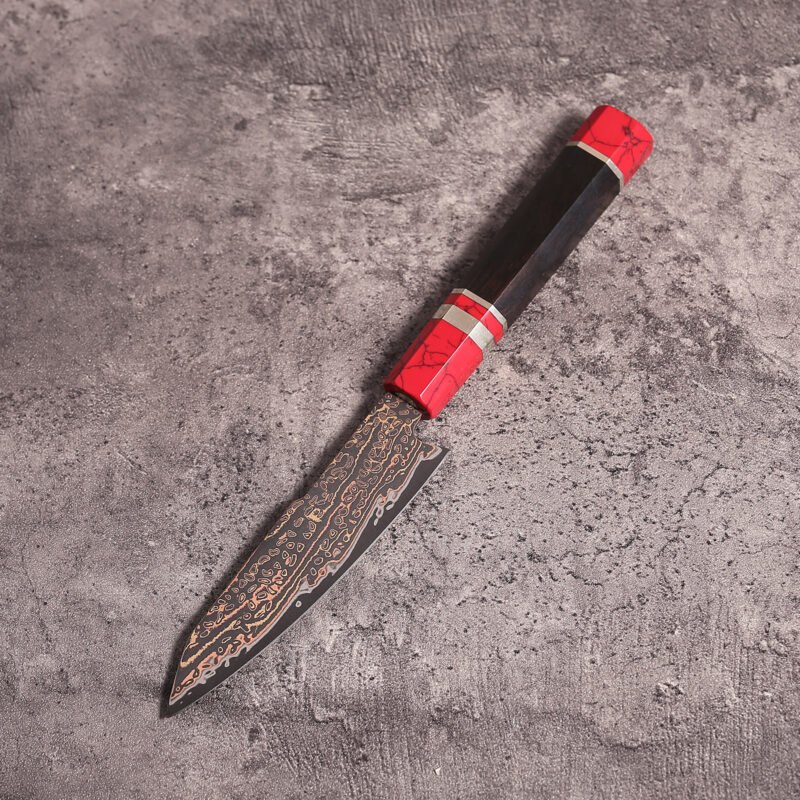
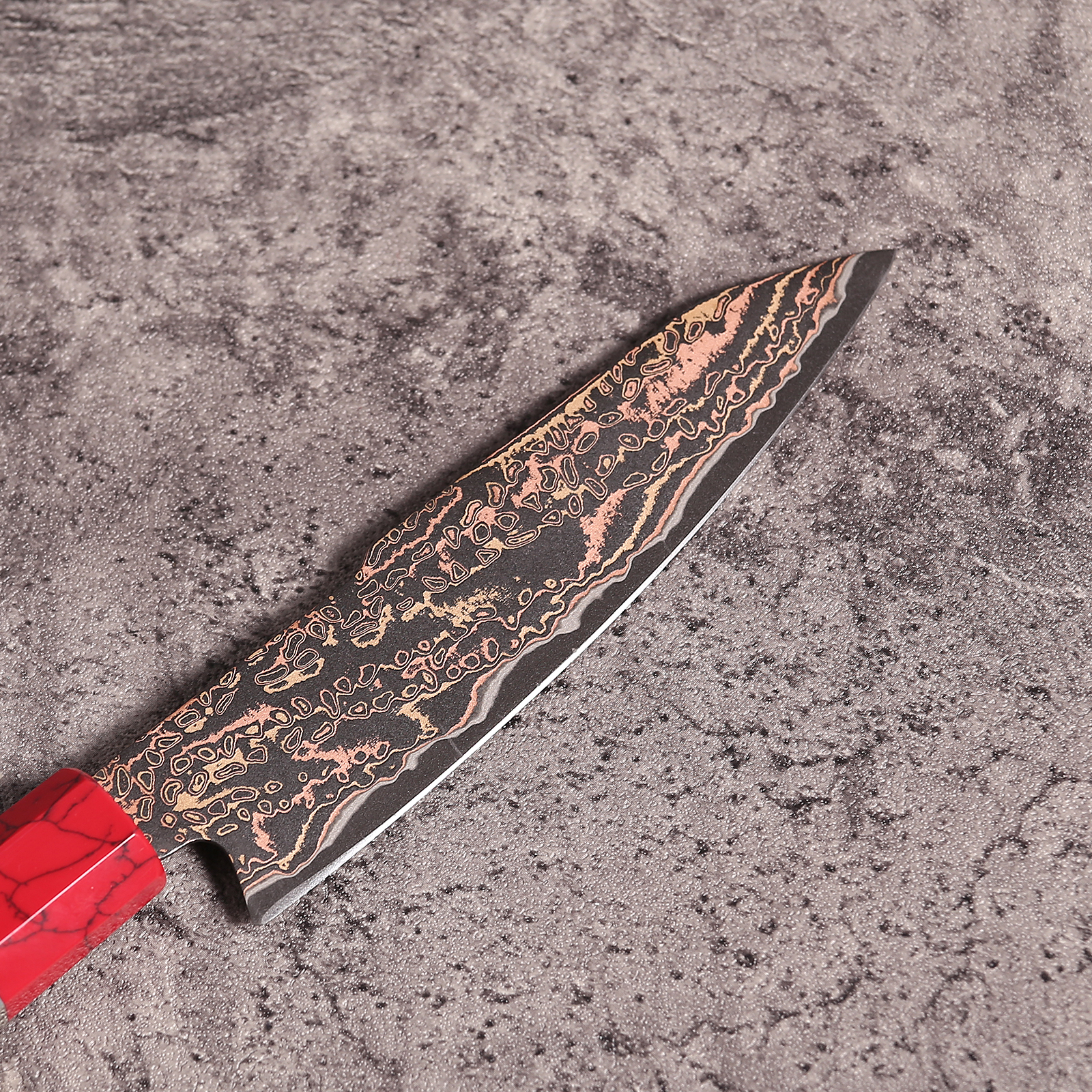
Actually, there is no limit to handle material colors — knife makers can craft any handle style to suit their vision. While traditional recommendations often suggest natural tones or dark hardwoods to complement the copper shimmer, you are free to use bright resins, neon G10, or any other vibrant material. The manufacturer supports full customization, allowing makers to create any handle design without restriction.
Here is an example of our completed knife for your reference.
Is wholesale pricing available for copper mai blanks?
Yes. Contact Joseph directly for volume pricing, MOQ, and mixed-profile order options. Copper mai blanks have a higher input cost than standard Damascus — wholesale pricing is structured accordingly.
