

Chef's Knives
Why the Santoku Knife Belongs in Every Retailer’s Lineup
May
There’s a reason the santoku has quietly become one of the best-selling kitchen knives in the world. It’s not marketing. It’s not trend-chasing. It’s just a very good knife that’s genuinely easy to love — and that makes it one of the most reliable products you can stock.
If you’re a retailer, distributor, or building a knife brand of your own, understanding what makes the santoku tick will help you buy smarter, merchandise better, and sell with real confidence.
The Knife That Sells Itself
Walk a customer over to a santoku and you have about thirty seconds to explain it. Fortunately, thirty seconds is all you need.
Santoku means “three virtues” in Japanese — the three being slicing, dicing, and mincing. That’s it. That’s the pitch. One knife, three things it does exceptionally well, and every single person who cooks understands exactly why that matters.
Compare that to trying to explain the difference between a boning knife and a fillet knife, or why someone might want a 10-inch chef’s knife over an 8-inch. The santoku skips the confusion entirely. It’s an approachable knife with a clear story, and that combination is rare in cutlery retail.
What Makes It Different from a Standard Chef’s Knife
The santoku grew out of Japanese kitchen tradition, but it was designed with a modern, all-purpose cook in mind. Unlike the classic Western chef’s knife — which has a pointed tip and a pronounced belly curve suited to a rocking chop — the santoku has a flatter edge and a blunt, dropped tip often called a “sheep’s foot.”
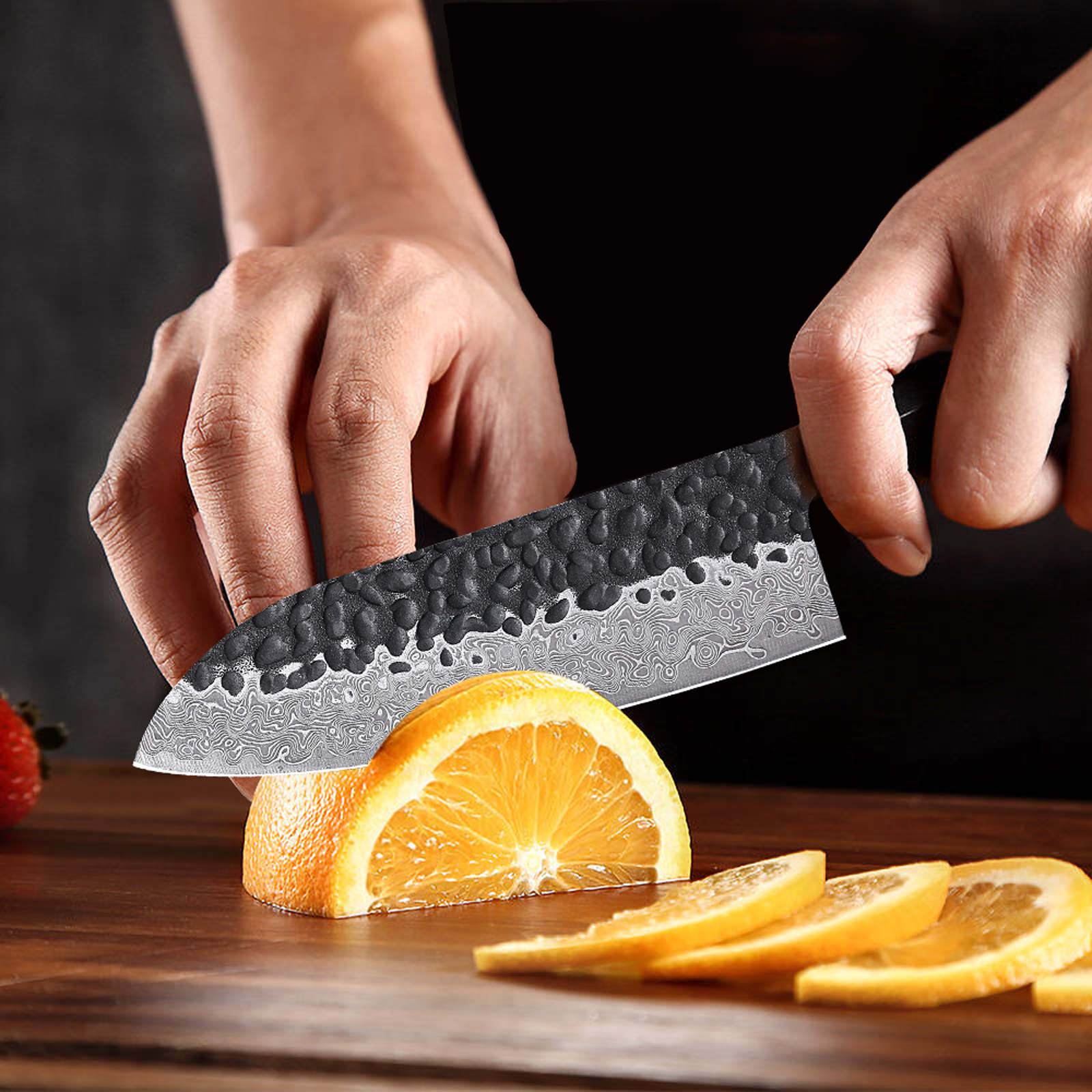
That flat profile encourages a clean up-and-down chopping stroke, which feels natural and precise. The blade is typically ground thinner than its Western counterpart, which means it arrives sharper out of the box and stays that way longer with proper care. Many versions also feature a granton edge — those small hollow dimples along the blade — which reduce drag and stop food from clinging to the steel mid-cut.
The result is a knife that feels lighter, more nimble, and more precise than most customers expect. The first time someone picks one up and uses it, there’s usually a moment of genuine surprise. That surprise is what drives word of mouth, repeat purchases, and five-star reviews.
Who Actually Buys a Santoku
The short answer: almost everyone.
Home cooks love it because it handles the daily workload — vegetables, boneless meat, herbs, fruit — without requiring any special technique. Culinary students gravitate toward it because it teaches clean, controlled cutting habits. Professional cooks often keep one as a secondary knife for detailed prep work. And gift buyers are drawn to it because it looks beautiful, has a great story, and feels like a thoughtful, grown-up present.

That kind of cross-category appeal is genuinely unusual. Most knives have a clear primary buyer. The santoku has five.
What to Look for When Sourcing
Not all santoku knives are built the same, and the difference between a good one and a forgettable one comes down to a few specific things.
Steel matters more than most buyers realize. A knife made from quality steel — something in the VG-10, AUS-8, or high-carbon stainless family — will hold an edge, sharpen predictably, and hold up over years of use. A knife made from vague “stainless steel” with no specification attached is almost always a compromise that customers will notice within a few months.
The grind tells the whole story. Pick up a santoku and look down the blade edge-on. A well-ground knife has a consistent, symmetrical bevel that tapers evenly to a fine edge. An inconsistently ground blade — thicker on one side, wavy, or visibly uneven — will feel dull no matter how sharp it technically is. This is the single biggest quality differentiator between price tiers.
Handle comfort seals the deal. Customers will pick up a knife, wrap their hand around it, and make a decision largely based on how it feels in the first three seconds. A handle that’s too thin, too slick, or poorly balanced will lose the sale. Look for handles with good weight distribution, a comfortable grip diameter, and materials that feel premium — pakkawood, G10, and quality composites all perform well at retail.
Fit and finish signals quality to the eye. Before a customer ever cuts anything, they’re looking at the knife. Clean welds, a straight spine, a polished bolster, and a blade that sits flush with the handle all communicate craftsmanship. These details matter enormously on the retail floor and in product photography.
Building a Santoku Assortment
A smart assortment doesn’t mean stocking twenty versions of the same knife. It means covering a few distinct customer needs cleanly.
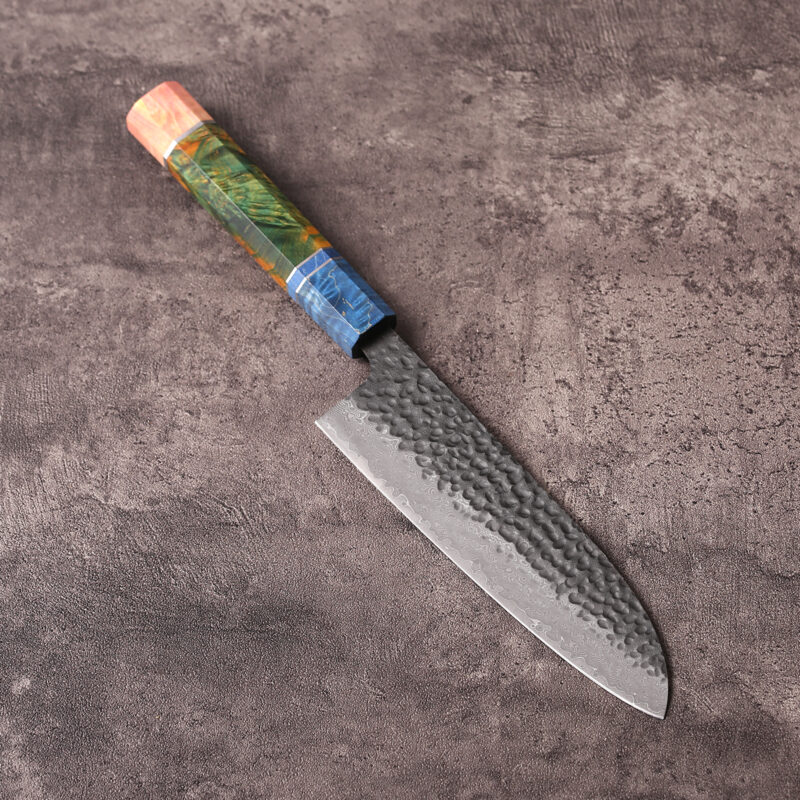
A solid entry-level santoku — good steel, comfortable handle, honest construction — gives you something for the value-conscious buyer and makes a great gift-set component. A mid-range option with better steel and a more refined finish serves the enthusiast who’s done a little research and wants to buy something they’ll keep for a decade. And a premium version, ideally with a Damascus-clad blade or a handsome wa-handle, gives you a halo product that elevates everything around it on the shelf.
You don’t need depth in every tier. Two or three well-chosen options will outperform a wall of similar knives every time.
Building Your Own Brand Around the Santoku
For many retailers, the next step beyond stocking knives is putting their name on them. Private label cutlery has become far more accessible over the past decade, and the santoku is one of the best knives to start with — recognizable enough that customers already want it, distinct enough that a well-branded version can stand on its own.
At WholesaleChefKnife.com, we offer both OEM and ODM services, which in plain terms means: whether you have a knife design ready to manufacture, or you want to build something from scratch, we can handle it.
Over 200 existing models are available for white label or custom branding right now. You pick the model, we put your brand on it — it’s the fastest route to a private label knife line with minimal development time or risk. If you want something more tailored, our ODM program lets you customize from the ground up: blade steel, blade geometry, handle material, handle shape, finish, and everything in between.
The steel and handle choices matter a lot here, not just for performance but for brand positioning. A santoku in AUS-8 with a black G10 handle reads very differently from one in VG-10 with an octagonal walnut wa-handle — same basic knife, completely different customer and price point. We’ll walk you through the options and help you match the spec to your target market, rather than just handing you a catalog and leaving you to figure it out.
The Support Behind the Product
One thing worth saying plainly: a lot of wholesale knife suppliers are essentially order-processing systems. You submit a PO, a container shows up, and if something’s wrong you’re on your own.That’s not how we work.Behind every order at WholesaleChefKnife.com are real people — account managers who know the product, technicians who can answer detailed questions about steel specs and manufacturing tolerances, and a team that’s genuinely invested in your business doing well. If you’re building a private label program for the first time, we’ve helped other buyers do exactly that. If you run into a sourcing problem or need to adjust a spec mid-run, there’s someone to call.
We also have an in-house photography team. This one comes up more than you’d expect. A lot of buyers — especially smaller retailers and e-commerce brands — don’t have access to professional product photography, and knife photography specifically is harder than it looks. Good lighting on a blade, the right background, the right angle to show the grind and the handle grain — it takes real skill. Our artists can shoot your products properly, which means you get images that actually sell the knife rather than just document it.
If you already have a creative team, great. If you don’t, we’ve got you covered.
The santoku isn’t a trend that arrived recently and might disappear. It’s been a staple of Japanese home kitchens for decades, and over the past twenty years it’s become a genuine global standard. The growth in interest around Japanese knives, Japanese cooking, and quality kitchen tools in general has pulled the santoku further into the mainstream — but it was already a great knife long before it became fashionable.
For retailers, that means you’re not betting on a fad. You’re stocking a product with deep roots, broad appeal, and a customer base that’s still growing.
That’s a good place to be.
WholesaleChefKnife.com supplies santoku knives and Japanese-style cutlery to retailers, distributors, and private label brands — with OEM, ODM, and product photography services to help you go further. Get in touch to request a catalog or talk through your program.
